Twice-daily feeding for broiler breeders offers promising advantages over traditional once-a-day schedules. Studies from Wageningen Livestock Research report improved growth uniformity, reproductive outcomes, and behaviour. This article explores the evidence and practicalities of split-feeding strategies for broiler breeders.
Traditionally, broiler breeders (particularly pullets) are fed once daily in the morning. However, feeding them twice daily, in a manner more aligned with natural behaviours, is emerging as a promising alternative. Wageningen Livestock Research has conducted multiple studies to evaluate this approach. Their findings suggest that twice-daily feeding during the rearing phase improves bodyweight uniformity, while extending this practice into the laying phase can enhance reproductive performance.
Current feeding practices and their limitations
During the rearing phase, breeder pullets receive a controlled feed allowance in the morning, right after lights come on. In the laying phase, feeding occurs either immediately after lights-on or approximately 6 hours later. Planning feeding times in this way helps prevent feeding during the critical window when most eggs, about 80-90%, are laid, thus reducing the incidence of floor eggs.
The limited morning feed allowance is consumed within 2-4 hours, which does not support optimal nutrient requirements for maintenance and egg production. Most females lay eggs in the morning, typically between 2 and 7 hours after lights-on. Within an hour after oviposition, the next yolk enters the reproductive tract. Albumen formation occurs over the next 6 hours, requiring protein, while eggshell formation takes place over the subsequent 18 hours, primarily requiring calcium.
Potential benefits of twice-daily feeding
Feeding breeders twice a day allows producers to more closely match nutrient delivery to the birds’ physiological needs during different stages of egg and eggshell formation. This approach can lead to improved shell quality and increased egg production. Furthermore, twice-daily feeding mirrors the natural feeding patterns of wild ancestors, supporting healthy biological and behavioural rhythms.
A natural perspective: Insights from wild ancestors
This hypothesis is supported by a 1967 study of Red Jungle Fowls in their natural habitat in North-Central India. The researchers found that these birds were active during dawn (feeding, drinking and egg oviposition) and dusk (feeding, drinking and mating), while resting in trees during the hottest part of the day. These findings suggest that both the ancestral and modern birds, are biologically adapted to a daily rhythm that includes feeding and drinking twice a day.
Ongoing research and trials
Given the potential benefits for eggshell quality, production performance, and behaviour, Wageningen University conducted several trials in both experimental facilities and commercial settings.
Twice-a-day feeding in the rearing phase: Research findings
In an experiment, starting at 3 weeks of age:
- Half of the Ross 308 pullets were fed once a day (at 08:15),
- The other half were fed twice a day (at 08:15 and again at 12:15),
With lights on at 08:00.
The pullets followed a 4-phase feeding programme:
- Starter-1 from 0-3 weeks of age,
- Starter-2 from 3-6 weeks of age,
- Grower from 6-17 weeks of age,
- Pre-breeder from 17 weeks of age.
The Ross 308 pullets were allocated to 24 floor pens in 2 identical rooms. Surprisingly, bodyweight uniformity at 10 weeks of age was better for the pullets fed twice a day compared to those fed once a day (CV%: 11.5 vs. 14.1, respectively), although no effect was found at 20 weeks of age (Table 1).
The positive effect of twice-a-day feeding on bodyweight uniformity was confirmed in a recent study conducted in collaboration with Aviagen-EPI. In that study, twice-a-day feeding improved bodyweight uniformity at 5, 10, 15, and 20 weeks of age. It was hypothesised that the enhanced bodyweight uniformity in both studies was due to physical factors, such as the size of the crop. When feed is provided once a day, particularly during the early rearing period (between 2 and 5 weeks of age), heavier pullets typically have a larger crop than lighter pullets, resulting in higher daily feed consumption. This leads to relatively higher bodyweight growth in the already heavier chicks.
However, when feed is provided twice a day, the smaller pullets can consume their portion during the first meal and empty their crop afterwards, making space for the second meal. Ensuring a quick and even distribution of feed (within 3 seconds) is crucial when implementing twice-a-day feeding during the rearing period. Twice-a-day feeding is only feasible with the development of a novel feeding system, the use of spin-feeders, or the use of (significantly) diluted diets.
Twice-a-day feeding and split-feeding in the laying phase
Standard practice and its limitations
Providing a limited amount of feed in the morning, which is consumed within 2-6 hours, is standard practice. Birds fed in this way learn to meet their feed requirements during a short period of intense feeding activity. However, this feeding practice does not optimally support the nutritional needs of breeder females for albumen and eggshell development.
Egg formation and nutritional needs
Approximately 90% of eggs are produced in the morning, between 2 and 7 hours after lights-on. After oviposition, ovulation occurs within an hour. In the first part of the reproductive tract, albumen formation occurs over a 4-hour period (late morning to late afternoon), primarily requiring protein and amino acids. Following albumen formation, eggshell formation occurs over the next 18 hours (evening and night), relying mainly on calcium from the feed or, during the night, from bone storage.
Advantages of twice-daily and split feeding
Twice-daily feeding (using the same breeder diet) can improve the availability of nutrients for both albumen and eggshell formation, potentially resulting in better egg and eggshell quality. Some older studies have shown that broiler breeder hens fed twice a day produce more eggs compared to those fed once a day.
In the past decade, an increasing number of layers have been fed specially formulated morning and afternoon diets (referred to as ‘split feeding’), which help meet the different nutritional needs during albumen and eggshell formation.
Research trials and key results
As a result, several trials were conducted at the experimental facilities of Wageningen University and in commercial settings, focusing on twice-a-day feeding and/or split feeding.
- The first trial was carried out with Ross 308 in small pens (30 females and 1-2 males) between 50 and 60 weeks of age.
- The second trial was conducted between 45 and 65 weeks of age.
In both studies at Wageningen University, no effects of twice-a-day feeding were found on eggshell quality, including breaking strength and eggshell thickness (Tables 2 and 3). However, interestingly, in both studies, a tendency toward higher egg production was observed in breeders fed via the split-feeding method. It is hypothesised that providing breeders with 2 meals per day better mimics the natural behaviour of the ancestral birds, which also fed twice a day. In physiological terms, feeding twice a day means that nutrients are spread across more moments throughout the day, potentially offering benefits for absorption and use at the optimal times of the day.
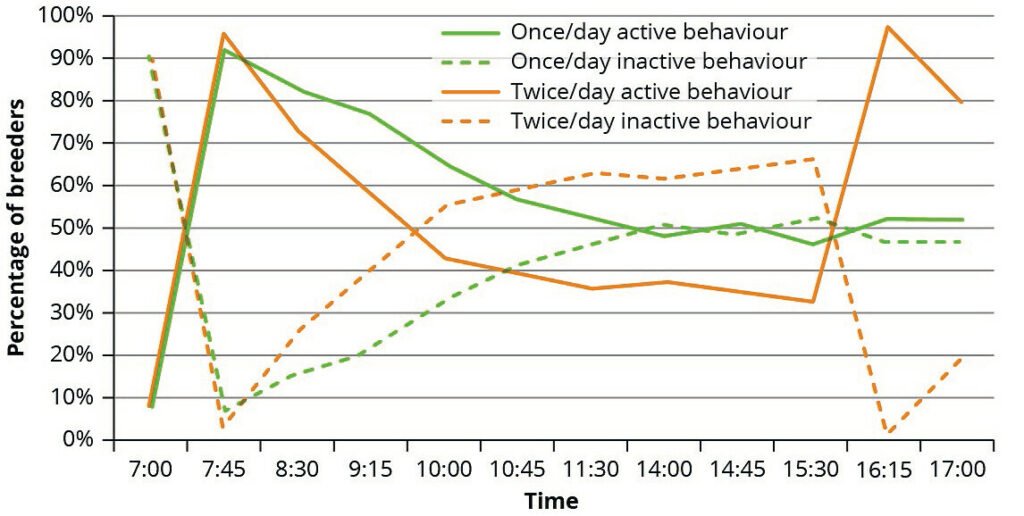
Figure 1 – Effect of twice a day feeding on activity-inactivity pattern during the laying phase.
Impact on activity, mating and fertility
Implementing twice-a-day feeding results in a different activity pattern throughout the day (Figure 1). Due to the second feeding time in the afternoon, breeders are more active during the last 4-5 hours of the light period. Observations of mating behaviour indicate that the majority of matings occur at the end of the day. The last 4-5 hours are biologically and physiologically the optimal time for egg fertilisation. Increased activity, particularly the mixing of females and males in the afternoon, leads to more mating activity, thereby promoting better fertility persistence as birds age.
This phenomenon was observed in an on-farm study in commercial broiler breeder houses. In that trial, 35% of the daily feed was provided 4 hours before lights-off, which increased activity for at least 3 hours. In one on-farm study, a 3% increase in fertility at the end of the laying phase (60 weeks of age) was observed when breeder females were fed twice a day. Mating behaviour observations during the afternoon feeding showed that, in houses with twice-a-day feeding, matings occurred 3.4 times more often compared to houses with standard morning feeding. It was hypothesised that the higher fertility was due to the increased activity at the end of the day in the houses with split feeding.
Practical implications
Challenges in the rearing phase
Feeding twice a day during the rearing phase presents a challenge due to the small amount of feed. This can be managed using a spin feeder, diluted diets combined with a winchable feeding system, or a novel feeding system designed to distribute the small feed amount evenly throughout the house.
Application in the laying phase
Feeding twice a day during the laying phase is easier because it typically starts at around 40 weeks of age. By this time, the daily feed amount is approximately 160 g, which can be divided, for example, into 100 g in the morning and 60 g in the afternoon. The transition from once-a-day to twice-a-day feeding should be spread over at least 3 days to allow the breeders to adjust to the new feeding method.
Considerations for male management
It is also important not to feed the males the second portion of feed, as they need to remain alert and ready for mating!