Probiotics have become a cornerstone of animal nutrition strategies as the industry continues to reduce antibiotic use and move away from antibiotic growth promoters (AGPs) globally. While characteristics such as strain identity and stability during feed processing remain important characteristics, a growing body of evidence shows that these features alone do not guarantee reliable effects in the gastrointestinal tract. Instead, a new differentiator is emerging: how quickly and consistently a probiotic becomes active inside the animal.
Among spore-forming products, this biological transition – known as outgrowth – is proving to be a critical factor in whether a probiotic can exert its intended function. This article explores why outgrowth speed matters, how modern in vitro methods help measure it, and what this means for in vivo outcomes.
The expanding role of probiotics in animal nutrition
Across all species, probiotics are increasingly used to support intestinal function and help animals cope with stressors such as diet changes, pathogen exposure, and environmental challenges. However, the diversity of probiotic types combined with differences in diet composition, feed processing, and farm management can lead to inconsistent results. Producers often report variable responses even when using established products. This variability has prompted researchers and nutritionists to look more closely at how probiotics actually behave inside the gut.
Spore-forming probiotics: robust, but inactive until they outgrow
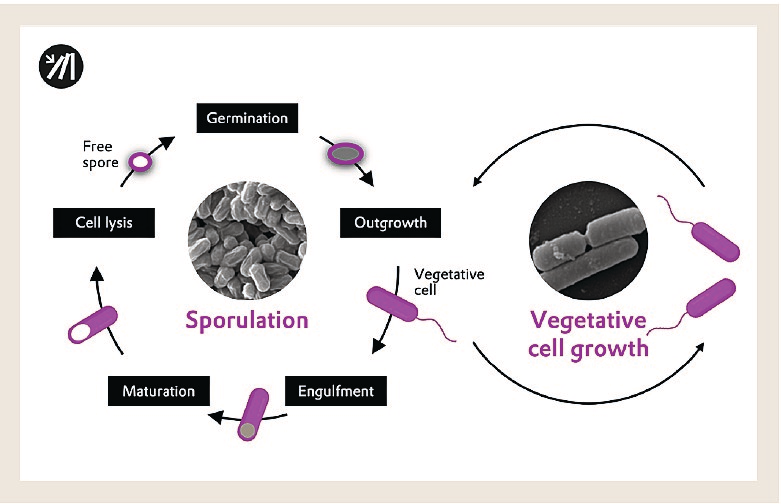
Spore-forming Bacillus probiotics are valued for one major reason: they survive conditions that kill many bacteria. The spore form protects the bacteria from heat, high pressure, and pH extremes, making them ideal for pelleting, storage, transport, and upper gastrointestinal tract passage. But this resilience comes with a tradeoff. Spores are biologically inert. They hardly interact with the gut environment, inhibit pathogens, and produce no metabolites or enzymes until they germinate and outgrow into vegetative cells.
This activation, germination and outgrowth typically occurs in the upper small intestine. In species with short intestinal transit times, such as broilers (especially young birds), this window of opportunity is narrow. If spores outgrow too late, they may pass through the gut before becoming functional. These insights have shifted attention toward the kinetics of probiotic outgrowth and guided the work on advanced products such as the improved Ecobiol by Evonik Industries AG, a Bacillus-based probiotic produced through advanced fermentation technology to support faster and more reliable outgrowth.
Why outgrowth speed and consistency matter
For a spore-forming probiotic to deliver benefits within the gut, timing matters just as much as survival. Outgrowth speed determines how early the probiotic begins interacting with the microbiota, its ability to compete with fast-growing pathogens or inhibit them, and how quickly it can contribute to intestinal resilience. A probiotic that outgrows rapidly in the duodenum and jejunum has more time to influence the gut environment where many key digestive and immune processes occur.
Consistency is equally important. Feed composition varies across production systems and regions – different grains, protein sources, additives, fat types, and processing conditions all influence germination. Products that perform well in one diet may germinate poorly in another.
This is where outgrowth characteristics begin to separate different Bacillus-based probiotics. Some strains show diet-dependent behavior, while others activate reliably across a wide range of feed types, like Ecobiol. Among the commercially available options, Ecobiol has been shown in recent in vitro work to germinate on average 46% faster than other spore-forming probiotic products, giving it a longer functional window in the intestine.

Modern methods for assessing probiotic outgrowth
Conventional lab media often mask real differences between probiotics because they do not reflect intestinal conditions. Modern in vitro systems overcome this by using specialised feed media (d-Feed), that is digested up to duodenum conditions, real-time metabolic assays, and gut-simulation platforms. These realistic models reveal true variation in how quickly and consistently different spores outgrow – distinctions that standard methods fail to detect. Using these models, Ecobiol consistently demonstrated rapid outgrowth across digested-feed media representing diverse diets across various regions.
Why this matters for animal nutrition and gut health
Fast and consistent outgrowth allows probiotics to engage with the gut much earlier, helping stabilise the microbiota during stress and offering timely competition against rapidly growing pathogens. Products that outgrow quickly tend to provide stronger support during intestinal challenges, with clearer benefits for resilience and gut integrity. If their performance is less dependent on diet, they also deliver more predictable results across farms.
Ultimately, a probiotic that activates reliably is more likely to express its full functional potential, improving overall value for producers. This has been reflected in trials where Ecobiol has been show to support stronger gut resilience under challenging conditions compared to probiotics with standard outgrowth speed.
Summary
As expectations for probiotic performance rise, the industry is moving beyond traditional metrics such as spore numbers, heat stability and shelf life. Outgrowth speed and consistency are emerging as practical, measurable indicators of how effectively a probiotic will perform inside the animal.
Spore-forming Bacillus probiotics have long been valued for their robustness, but it is their ability to become metabolically active cells at the right time – and in a wide range of diets – that ultimately determines their impact on gut health.
Modern in vitro systems now allow nutritionists to assess these characteristics more accurately, providing a clearer basis for product selection. Faster, more reliable outgrowth is becoming a defining feature of next-generation probiotics and a new benchmark for supporting gut resilience in commercial livestock systems.