As antibiotic restrictions tighten in modern poultry farms, producers are urgently seeking effective ways to boost disease resistance, growth, and feed efficiency—without relying on traditional drugs. New research reveals that combining microencapsulated butyric acid with yeast culture delivers powerful, synergistic benefits for broiler gut health, performance, immunity, and meat yield.
In some poultry production systems, sub-therapeutic antibiotics are frequently used to promote growth and guard against bacterial infections. However, the growing restrictions on antibiotic use in animal production have prompted the development of alternatives to antibiotic growth promoters (AGPs). Research work shows the potential of yeast-based products and organic acids in poultry production; however, their combined application or synergistic effects have been limited. In a study published in the Veterinary Sciences journal, researchers assessed the synergistic effects of microencapsulated butyric acid and yeast culture supplementation on gut health, growth performance, carcass traits and immune status in broilers.
Study design and supplementation approach
The study examined the potential benefits of integrating microencapsulated butyric acid (EBA), which enhances gut health and digestion, and yeast culture (YC), which boosts immune and nutrient absorption, on broiler health and growth performance. The study assessed the impact of these supplements individually and in combination. A total of 450 Ross-308 broiler chicks were allocated to five dietary treatments as follows:
- Negative control (NC) diet: group fed basal diet without any additives.
- Positive control (PC) diet: group fed basal diet + 0.2 g/kg enramycin.
- EBA diet: group fed basal diet + 0.3 g/kg EBA (microencapsulated butyric acid)
- YC diet: group fed basal diet + 1 g/kg YC (yeast culture).
- EBA+YC diet: group fed basal diet + 0.3 g/kg EBA and 1 g/kg YC.
Improved growth performance and carcass yield
The study showed that butyric acid and yeast significantly improve feed intake and growth in broilers. Supplementation with individual butyric acid and yeast also improved feed utilisation efficiency, as evidenced by low FCR values (Table 1). The improvements were attributed to the organic acid’s low pH, antibacterial properties, and ability to enhance protein digestion; similar studies have also attributed improvements in growth to the organic acid’s effects on the digestibility of protein and energy in broiler diets.
Our findings suggest that microencapsulated butyric acid and yeast culture supplementation can be a good substitute for antibiotic growth promoters, reducing disease incidences while promoting sustainable poultry production.
In agreement with the results obtained in this study, another group of researchers reported improved growth when yeast was supplemented. Similarly, research published in the British Poultry Science and Animals journals found that supplementing broiler diets with yeast improves digestion, gut health and nutrient absorption, resulting in better growth. Yeast culture contains various components, including β-glucans, which have been shown to positively influence intestinal health in broiler chickens through diverse mechanisms. In the current study, high carcass and breast yields and organ weights (spleen and bursa) were obtained with individual supplementation of the additives, whereas their combination further improved carcass yield (Table 1).
Enhancing gut morphology and immunity
An essential indicator of intestinal health is the ratio of villus height (VH) to crypt depth (CD). The results of this study showed that butyric acid and yeast supplementation significantly increased villus height, crypt depth, and the VH:CD ratio (Table 2). A high VH-to-CD ratio indicates a long villus with an epithelium sufficiently mature and functionally active, in combination with a shallow crypt with constant cell renewal. The improvement in intestinal morphology is associated with better digestion and absorption of dietary nutrients, which relates to the observed improvement in FCR. These improvements in intestinal morphology were explained by butyrate absorption by enterocytes, its role as an energy source, and its effects on enterocyte development, differentiation, and proliferation, ultimately improving gut health in birds. It was concluded that supplementing with butyric acid and yeast increases intestinal absorptive area by enhancing villus proliferation and gut health; the combination showed even better results, confirming a synergistic effect.
The immune system plays a significant role in regulating poultry health and preventing disease. In this study, the titre against Newcastle disease virus (NDV) was higher for the diets supplemented with butyric acid and yeast. This was attributed to the butyric acid effect on reducing intestinal pH and increasing intestinal integrity, which enhances the immune response. On the other hand, it was suggested that the oligosaccharides found in yeast walls might bind to viruses and serve as vaccine adjuvants, boosting antibody production by the humoral immune system. The additives also increased the weights of immune-related organs (spleen and bursa), confirming an improved immune response (Table 1).
Greater antimicrobial effects in the intestine
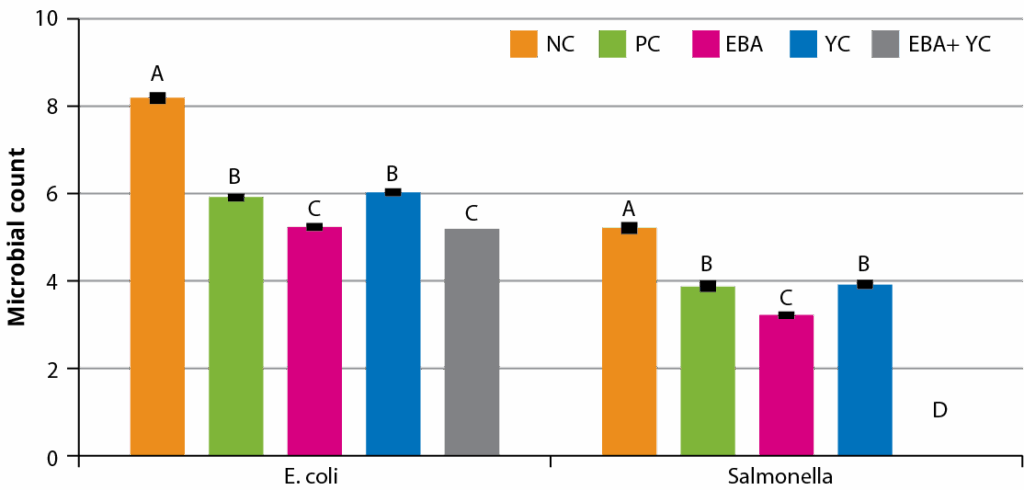
The findings of this study showed a synergistic effect of butyric acid and yeast on the gut microbiota of broilers; the additives significantly reduced Salmonella and E. coli counts (Figure 1) in the small intestine. According to the researchers, this could be explained by the lower gut pH caused by the acid, which is detrimental to the growth of acid-intolerant coliforms.
Figure 1 – The effects of treatments on the ileal microbial count at day 35 (different letters on the bar show a significant difference).
A sustainable alternative to antibiotic growth promoters
This research demonstrated the synergistic effect of microencapsulated butyric acid and yeast culture supplementation on enhancing gut health, growth, immunity and carcass yield in broilers. The researchers concluded that “Our findings suggest that microencapsulated butyric acid and yeast culture supplementation can be a good substitute for antibiotic growth promoters, reducing disease incidences while promoting sustainable poultry production.”