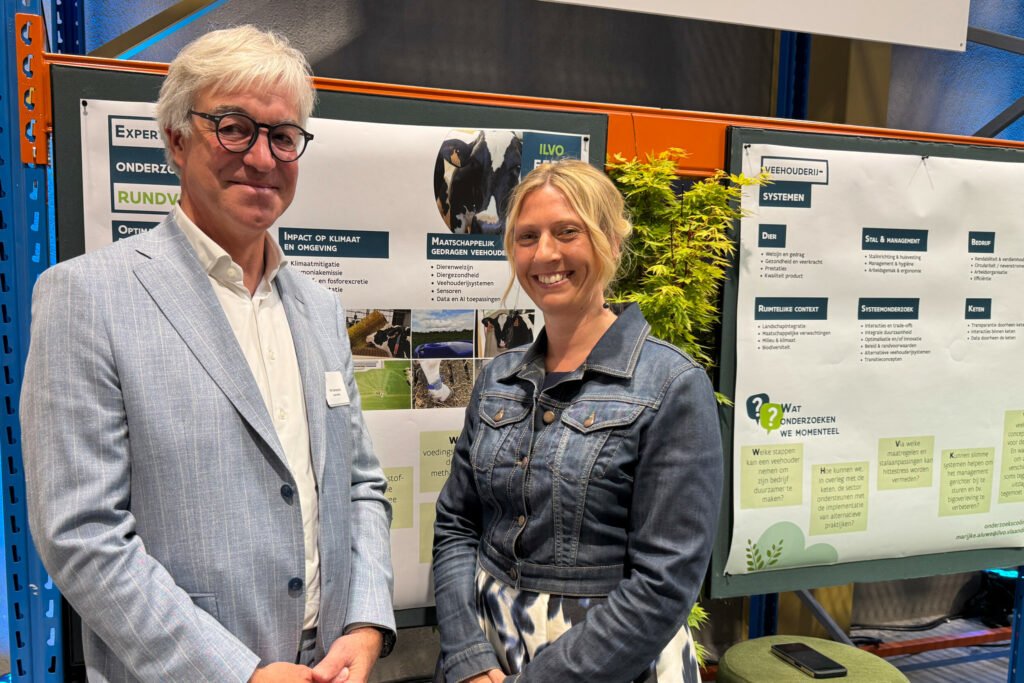
The Belgian Feed Association (BFA) held its annual general meeting at ILVO’s research campus in Melle on 23 April. On the same day, the institute officially opened its new Feed Pilot facility. Amid geopolitical turbulence, disease pressure and mounting regulatory demands, the sector’s message was, somewhat surprisingly, one of confidence.
Belgium’s compound feed sector produced 6.75 million tonnes in 2025, a modest increase of 0.6% on 2024, and total turnover reached €6.3 billion. While these numbers are hardly spectacular, in a year punctuated by trade disruptions, animal disease outbreaks and growing policy pressure, stability was the goal, not growth.
“For the third year in a row, a proud chairman stands before you,” BFA chairman Rik Vandeputte told members at the opening of the meeting. “After a top year in 2024, with growth of 4.8%, we were able to consolidate in 2025 with modest growth of 0.6%. Perhaps less spectacular. But let us be honest: that is simply strong, certainly when you compare it with our neighbouring countries.”
Market segment trends
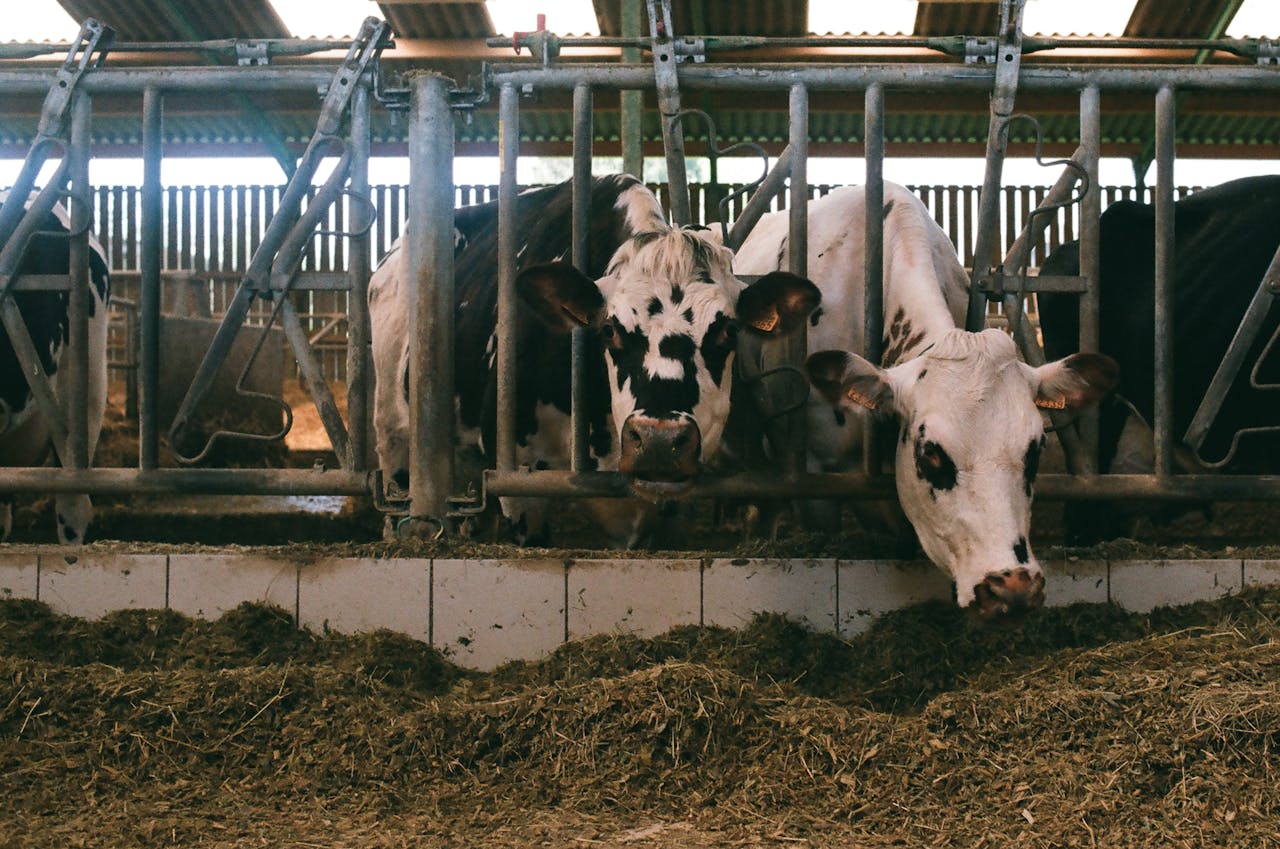
Pig feed remains the dominant segment, representing 48% of the country’s feed sector, followed by cattle feed at 23% and poultry feed at 20%. By BFA’s calculations, poultry feed grew by 3.3% and feeds for horses, hobby and companion animals by 2.8%. Pig feed dropped slightly at -0.4%. The production of premixes and additives declined 4.5% to 225,761 tonnes.
Stability under pressure
Given the volatility surrounding the feed sector, its relative stability is all the more impressive. “We are getting another war on top of everything, with all the consequences that entails; energy prices, uncertainty, and geopolitical tensions,” he said.
“Our businesses do not run on slogans. They run on continuity, reliability, and craftsmanship.” – Rik Vandeputte, BFA Chairman
Trade, he added, has also become less predictable. “Decisions are more often made with a short-term perspective,” he said. “And the world sometimes seems to revolve mainly around symbols and hollow slogans. But our businesses do not run on slogans. They run on continuity, reliability, and craftsmanship.”
BFA Managing Director Katrien D’hooghe echoed Vandeputte’s points in her own address, pointing to the sector’s track record as evidence of genuine resilience.
“Within a challenging context and against this complex backdrop, we demonstrate our resilience and take our responsibility,” she told members.
The tools for doing so, she said, are practical ones; strong technical performance, efficient feed conversion, and the processing of by-product streams from the food and biofuel industries that would otherwise go to waste.
Regulatory and supply risks
A challenging regulatory environment has added its own layer of complexity. The EU Deforestation Regulation, currently delayed, continues to generate uncertainty over the availability and cost of soy and soymeal. D’hooghe estimated the compliance cost for Belgium alone at €2 million, with the figure running above €1 billion at European level.
“The postponement of the EUDR is a step in the right direction,” Vandeputte said during his speech. “Again an important signal. But words alone are not enough. They also need to be translated into action.”
D’hooghe raised concerns about vitamins and amino acids and the vulnerable position of relying on a single market for their supply. More than 80% of Belgian feed raw materials are sourced within Europe, but protein-rich ingredients and specific additives remain heavily dependent on imports, particularly from China. D’hooghe flagged this as a structural risk that FEFAC, the European feed federation, has been mapping carefully.
The irony is not lost on the sector – amino acids, sourced largely from China, are also one of the tools used to reduce ammonia emissions and limit dependence on imported soya. “This all forms a very precarious balance,” D’hooghe said.
Measurable progress
Not all the news is cautionary. The sector’s antibiotic reduction programme stands as one of the great achievements in European livestock production. In 2025, the use of antibiotics in medicated pig feeds (measured in active substance) was 92% lower than in 2011. By the end of 2026, the production of antibiotic-medicated animal feeds in Belgium will cease entirely. “Quite a challenge, but we are almost there,” D’hooghe said.
The result, she stressed, was not achieved by any single player. “This result could only be achieved through cooperation between the various parties involved; the livestock farmer, the veterinarian, and the animal feed manufacturer,” she said.
Disease and biosecurity
Disease pressure remains a key concern. Last winter, Belgium recorded 23 outbreaks of avian influenza. Swift action by the sector and the Federal Agency for the Safety of the Food Chain (FASFC) resulted in the country being declared free of the disease by the World Organisation for Animal Health.
BFA played a small but important role in these results. The organisation updated and simplified its biosecurity protocol, re-approved by the FASFC, which scales its requirements according to the severity of the disease situation while ensuring feed supply to all animals is maintained.
Pig market recovery
The pig sector, which endured low meat prices through the first half of 2025, is beginning to recover. “We have been seeing a turnaround for several weeks,” Vandeputte said. “The market is slowly picking up again.”
On this note, he was less optimistic and more practical. “It shows how quickly balances can shift,” he said. “Therefore we must stay alert. Not panicking, but also not being naïve.”
Sustainability initiatives
On the sustainability front, BFA spent 2 years developing a standardised methodology to calculate the ecological footprint of Belgian pig feed, working in coordination with Pork.be and using ILVO to benchmark competing calculation tools. The resulting system feeds data automatically into Klimrek, a web-based LCA platform used by pig farmers, and is now being rolled out internationally through GMP+. A new VLAIO-funded project, Qualimix+, launched on 1 April under Ghent University’s leadership, will focus on strengthening food safety culture within the sector, with particular attention to sampling procedures and traceability.
A new facility, a shared future
The choice of venue for this year’s AGM was no accident. ILVO’s Melle campus had, just hours earlier, officially opened its Feed Pilot — a €6 million experimental feed production facility funded primarily by the Flemish government, with additional support from the European Regional Development Fund, the province of East Flanders, and the Victam Foundation.
“We are not a passive sector. We are a sector that adapts, innovates, and keeps investing.”– Rik Vandeputte, BFA Chairman
The facility houses 2 production lines with more than 30 machines. Together, they are capable of producing precision test feeds in batches ranging from a few tens of kilos to several thousand kilos, with accuracy to one gram. Basically, the facility replicates the key processes of a commercial feed mill, but at research scale.
Real-time nutritional analysis is performed at each production stage using NIRS technology. The building is open to feed companies, food processors, academics, and policymakers.
Flemish Minister of Agriculture Jo Brouns, who operated the first machine at the opening ceremony, described it as strengthening “our knowledge position and our strategic autonomy in the feed chain.”
Hosting its AGM at Feed Pilot underscored BFA’s key message about a sector in transition. “What happens here is exactly what our sector needs – science that connects to practice,” said Vandeputte. “Innovation that is effectively applicable. Research that makes progress possible.”
D’hooghe went a step further, pointing to the facility’s role in the Qualimix+ project and in the ongoing development of feed sustainability tools. She closed the AGM with a question she said the sector is increasingly asking itself: “Will our food supply be alright?” The answer, she said, lies in continuing to build bridges between knowledge and practice – and that is just what the Feed Pilot represents.
“We are not a passive sector,” concluded Vandeputte. “We are a sector that adapts, innovates, and keeps investing.”