Feed tests show what could be risky. Blood tests show what is really going on. By analysing a single drop of blood, nutritionists can now see which mycotoxins animals have actually absorbed — turning guesswork into measurable evidence and revealing the real extent of hidden contamination.
Developed in collaboration with Ghent University, blood analysis was designed to capture real exposure using advanced liquid chromatography-mass spectrometry (LC–MS/MS). This scientifically validated method detects and quantifies 36 mycotoxin biomarkers (including mycotoxin metabolites) from a single drop of blood, providing a unique and scientifically robust overview of systemic toxin exposure.
Samples are collected on FTA cards, making the approach practical for routine farm use. The technology measures the toxins the animal has actually absorbed — providing the missing link between toxin exposure, animal status and overall performance.
Global and extensive validation
Since its implementation, over 10,000 blood samples from ruminants, pigs and poultry from more than 40 countries worldwide have been analysed. The resulting dataset confirms consistent results validating both the method’s precision and its global applicability. Moreover, it provides a unique scientific foundation to benchmark exposure trends and quantify the real extent of hidden mycotoxin challenges.
Seeing the full picture
Global application has demonstrated that blood analysis consistently detects a higher incidence of mycotoxin exposure than feed testing. In fact, in 82% of farms, one or more mycotoxins detected in blood were missed in feed. This contrast highlights how blood testing delivers a far more accurate and biologically relevant picture of mycotoxin risk. What’s more, when blood was added, five or more mycotoxins were detected in 50% of the cases. Such co-exposure to multiple mycotoxins has a significantly greater toxic impact on animals than individual toxins alone.
The hidden majority: Emerging mycotoxins
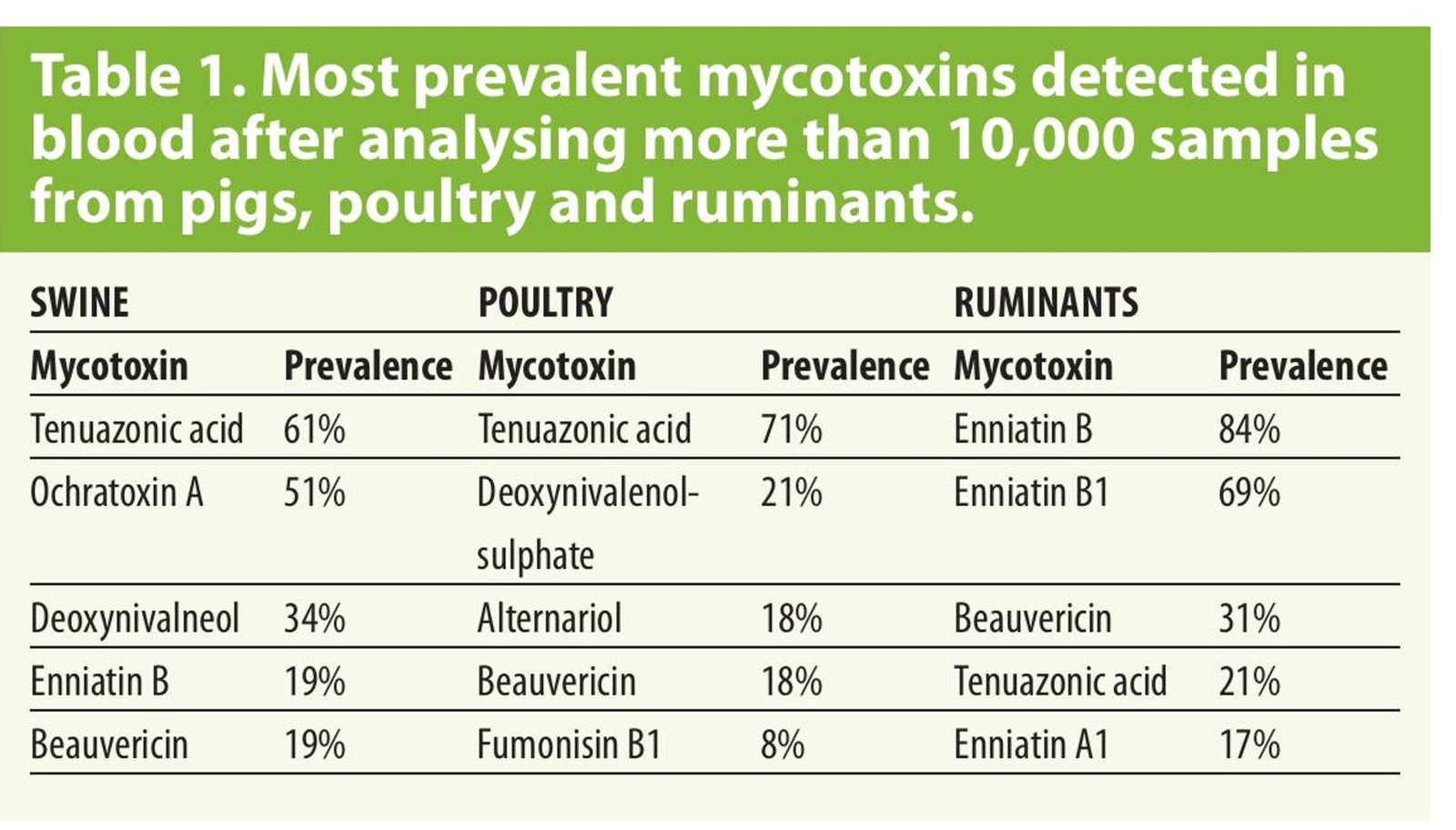
Traditional routine programmes focus on regulated toxins such as aflatoxin, deoxynivalenol, fumonisin and zearalenone. In recent years, advances in LC–MS/MS technique have made it possible to expand the range of mycotoxins analysed. Thus, numerous scientific feed surveys have since shown that emerging mycotoxins, such as beauvericin and tenuazonic acid, are among the most prevalent contaminants worldwide (Table 1).
Also, blood analysis has confirmed a significant and consistent presence of emerging mycotoxins — notably enniatins, beauvericin, tenuazonic acid and alternariol. In fact, on 67% of monitored farms, there was exposure to tenuazonic acid. The message is clear: managing only the regulated toxins leaves dangerous blind spots.
When biomarkers meet outcomes
Mycotoxin analysis in blood has shown its ability to convert analytical biomarker data into measurable indicators of health status and productive performance. Patterns from thousands of blood analyses have revealed clear associations between specific mycotoxins and field disorders. For the first time, large-scale field data have confirmed that poultry flocks affected by necrotic enteritis are more exposed to deoxynivalenol and fumonisins, establishing in commercial settings a link that, until now, had only been demonstrated in experimental studies.
Similarly, in pig herds with respiratory disorders, blood biomarker analysis identified elevated fumonisin concentrations, linking these findings to the impaired lung function described in the scientific literature. These correlations establish biomonitoring as a predictive diagnostic approach, enabling the early identification of subclinical challenges that precede visible symptoms or production losses.
Linking exposure and performance
 In many farm situations, mycotoxin exposure does not lead to obvious clinical symptoms, yet it can still compromise productivity. Subclinical contamination often remains unnoticed until performance losses become measurable. Controlled field observations have shown that even low systemic concentrations of mycotoxins can impair animal performance.
Within the Biomonitoring+ programme, reductions in circulating toxin biomarkers have been consistently associated with improvements in key productive parameters, including enhanced feed conversion ratios in broilers and lower mortality rates and higher productivity in layer flocks managed through biomarker monitoring.
Overall, these findings demonstrate that blood biomarkers are not only diagnostic indicators but also reliable predictors of animal performance.
Tracking the invisible: vertical transfer
Blood analysis has also uncovered the vertical transfer of toxins from breeders to offspring. Mycotoxins have been detected in one-day-old piglets and pullets before any feed intake. Early exposure like this is tied to reduced immunity and slower early growth. Biomonitoring allows such transmission to be measured, predicted and ultimately reduced through targeted management.
Measuring success, not promises
For years, the efficacy of mycotoxin detoxifiers was assessed mainly through in vitro binding tests, which do not accurately reflect what occurs inside the animal. Biomonitoring overcomes this limitation by measuring toxin biomarkers in the blood before and after supplementation, providing direct in vivo evidence of efficacy.
In field applications, inclusion of Escent for 30 days led to a progressive reduction — and in many cases, complete removal — of detectable mycotoxins in blood. The reduction of mycotoxin levels could be correlated with improvement in animal status. For this reason, biomonitoring offers a unique and reliable approach to evaluating detoxification strategies under real production conditions.
Toward predictive management
Biomonitoring+ marks a shift from reactive correction to predictive control. Rather than waiting for symptoms or relying solely on feed analysis, nutritionists and veterinarians can now see and quantify the animal’s actual exposure in real time. This science-based approach transforms mycotoxin management into a proactive system that protects performance and drives sustainable production. With every blood sample, data turn into foresight — and foresight into healthier, more efficient herds and flocks. Stop assuming. Start Biomonitoring.