While farmers and veterinarians typically associate mycotoxin issues with clear clinical symptoms, the first effects occur silently and gradually, affecting productivity long before visible signs appear. Even low dietary concentrations can compromise gut integrity, immune defense, and feed efficiency – key pillars of profitable poultry production.
To protect the health of the birds and ensure food safety, many regions have established maximum recommended levels of major mycotoxins in poultry feed. In Europe, these include 20 ppb (µg/kg) for Aflatoxin B1 (AFB1), 5,000 ppb for Deoxynivalenol (DON), 100 ppb for Ochratoxin A (OTA), and 20,000 ppb for Fumonisins (FUM). However, recent EFSA re-evaluations are challenging these standards.
Emerging data shows that even concentrations below the current guidance values can alter intestinal function, oxidative balance, and immune responses. Consequently, EFSA has proposed stricter limits for certain toxins such as DON and OTA, acknowledging that feed safety cannot rely solely on visible toxicity thresholds.
Polycontamination – the rule, not the exception
Field data confirms that modern poultry production rarely faces single-mycotoxin challenges. An analysis of more than 25,000 feed and raw material samples collected worldwide between 2013 and 2024 revealed that 85% of raw materials and 94% of finished feeds contained multiple mycotoxins. Most of these polycontaminated samples showed levels below EU guidelines, highlighting that chronic exposure to low doses of several toxins has become the norm rather than the exception.
Scientific literature reinforces this concern: even sub-guideline concentrations can impair feed conversion ratio, increase susceptibility to pathogens, and trigger intestinal and hepatic oxidative stress.
Low dose of DON affects gut health
A controlled experiment conducted at Schothorst Feed Research evaluated the effects of moderate natural contamination with Deoxynivalenol (DON). Broilers were fed either a Control diet marginally contaminated with DON (~0.2 ppm) or a naturally contaminated diet containing ~3 ppm DON (still below the EU guidance value of 5 ppm).
Two groups received the contaminated diet: one without supplementation (DON group) and one supplemented with 2 g/kg of an Algoclay-based product (Algoclay group).
DON exposure induced villus damage at day 28 and villus shortening at day 37, along with increased hepatic expression of glutathione synthetase (GSS), a biomarker of oxidative stress. Remarkably, these effects were absent in birds receiving the Algoclay-supplemented diet, with maintenance of intestinal morphology and oxidative status comparable to the control group.
This trial clearly demonstrates that even moderate DON contamination can disturb gut structure and induce oxidative stress (these negative effects were absent in the group supplemented with Algoclay).
Reducing systemic mycotoxin exposure
Given that low-level contamination can impair performance, effective mitigation requires reducing mycotoxin absorption and epithelial interaction within the gut. Among available technologies, hybrid adsorbents combining mycotoxin binder clay minerals and marine polysaccharides (Algoclay) have proven effective in limiting mycotoxin bioavailability.
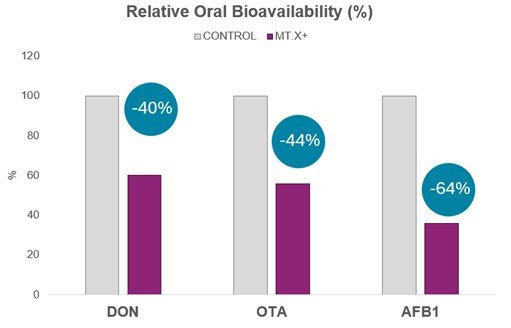
In a toxicokinetic study at Ghent University, broilers received a single oral bolus containing DON (5 mg/kg), OTA (2.5 mg/kg), and AFB1 (20 mg/kg), simulating field exposure to several mycotoxins. Birds supplemented with 2.5 g/kg of Algoclay-based product (MT.X+) showed a marked reduction in plasma biomarkers: -40% for DON, -44% for OTA, and -64% for AFB1, confirming the product’s ability to reduce systemic mycotoxin exposure across different mycotoxins.
Integrating science and management: Myco’Kingdom Platform
Managing mycotoxin risk effectively requires a holistic approach that combines field monitoring, analytical insights, and precision application of mitigation tools. To support this, Olmix has developed Myco’Kingdom, an integrated platform that enables data-driven decision-making.
- Myco’Evaluator assists nutritionists and veterinarians in on-farm risk assessment.
- Myco’Screen provides customised contamination reports tailored to feed composition and regional risk.
- Myco’Calculator helps optimise the dosage of Algoclay-based solutions according to feed contamination patterns.
Together, these tools allow feed millers and integrators to translate complex contamination data into practical action, ensuring consistent animal health and performance even under polycontaminated conditions.
Key takeaway
Global feed contamination remains a major challenge, but the real risk comes from exposure to low doses and multiple toxins that fall below traditional control thresholds. There is growing scientific and practical evidence confirming that ‘less’ can still be ‘too much’ when it comes to mycotoxins.
Algoclay technology offers a robust, scientifically validated strategy for minimising exposure and reducing damage and oxidative stress, while the Myco’Kingdom platform enables professionals to manage risk with precision and confidence.