Understanding how amino acids affect appetite is key to optimising chick nutrition. Recent research uncovers rapid-acting signals that influence feeding in newborn chicks. These findings could shape more effective feed strategies for improved poultry performance.
Ensuring that chicks receive optimal nutrition is vital for their early growth and long-term productivity. In a review article published in The Journal of Poultry Science, Dr Phuong V. Tran summarises current understanding of how amino acids and their metabolites regulate appetite in neonatal chicks.
Amino acids as satiety signals
Dr Tran highlights that compounds such as L-ornithine act as rapid satiety signals that interact strongly with the appetite-stimulating neuropeptide Y, offering insights to improve feeding strategies in poultry production.
Understanding appetite regulation in poultry
In the poultry industry, ensuring chicks receive optimal nutrition is paramount as it influences their early development, health, and long-term productivity. For decades, scientists have tried to unravel the biological mechanisms that control appetite and satiety during the early developmental phases of chicks – a key step toward designing effective feeding strategies.
Chicks as research models
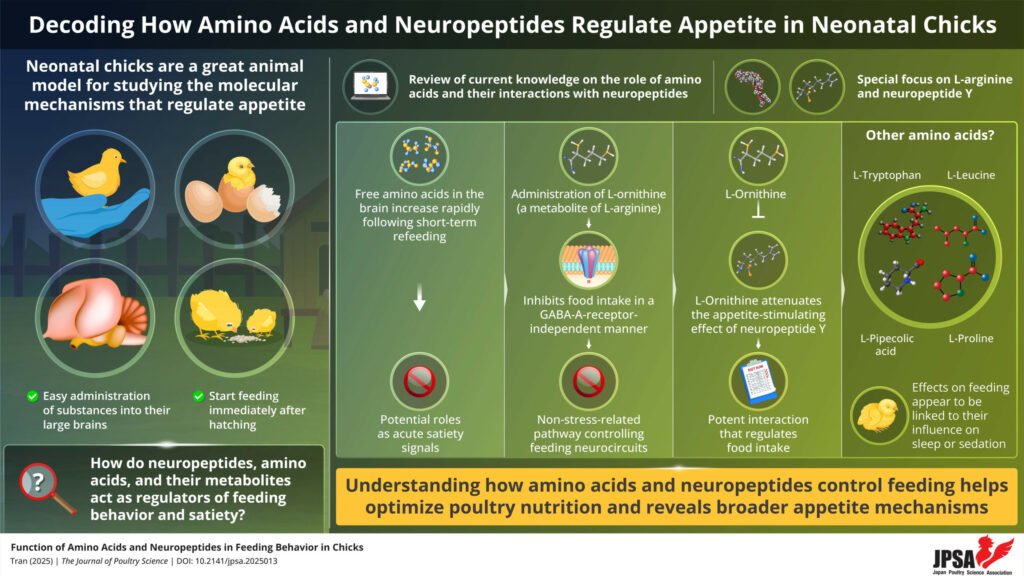
Interestingly, neonatal chicks are an excellent animal model for studying such biomolecular processes in detail. They are a precocial species that begins searching for food immediately after hatching, and their relatively large brains make it easier to administer substances directly into their central nervous system during experiments.
Gaps in research remain
However, despite decades of research, many aspects of appetite regulation in chicks remain poorly understood. Chicks exhibit very short and frequent eating bouts separated by brief resting periods.
Role of rapid-acting factors
While appetite is known to be regulated by neuropeptides, these signalling molecules take time to synthesise and act, implying that some other fast-acting signal must be controlling satiety. Could free amino acids, which are rapidly influenced by nutrient uptake, be involved in this process?
Focus on amino acids and NPY
Dr Tran from the Graduate School of Bioresource and Bioenvironmental Science, Kyushu University, Japan, analyses current knowledge on the regulation of food intake in neonatal chicks. The review focuses specifically on the role of amino acids and their metabolites and how they interact with the appetite-stimulating neuropeptide Y (NPY).
L-ornithine in appetite control
The analysis highlights that short-term refeeding leads to a rapid increase in the concentration of several free amino acids in a chick’s brain, supporting their role as acute satiety signals. In particular, L-ornithine, which is a metabolite of the amino acid L-arginine, had a potent effect on appetite, inhibiting food intake in a dose-dependent manner. Unlike other appetite-regulating mechanisms, L-ornithine appears to act independently of stress-related pathways.
Interactions between L-ornithine and NPY
One of the most critical findings detailed in the review was that, when co-injected with L-ornithine, the strong appetite-stimulating effect of NPY was significantly attenuated.
Fast-acting appetite regulation
“This implies a potent interaction in the brain between the regulation of food intake by NPY and acute satiety signals by L-ornithine,” remarked Dr Tran. This interaction suggests that L-ornithine acts as a brake on the NPY-driven urge to eat, providing a fast-acting regulatory loop necessary for the chick’s frequent feeding behaviour.
Roles of other amino acids
The review also examined the roles of other amino acids, such as L-tryptophan and L-proline, noting that their effects on feeding are often tied to their influence on sedation and sleep, which frequently follows a feeding bout in neonates.
Implications for feed strategies
The various studies and key findings outlined in this review have implications that bridge basic biology with practical applications. Understanding the key role of amino acids in the central nervous system of neonatal chicks can be used to optimize dietary amino acid formulations. This ensures chicks receive the best possible nutritional start, leading to healthier flocks and improved poultry performance.
Broader applications in animal science
Moreover, insights into appetite biology gained using neonatal chicks as an animal model could have parallels in mammals, which are harder to study.
Future directions for research
The continued exploration of these mechanisms could not only improve poultry nutrition and productivity but also deepen our understanding of how the brain regulates feeding across species.