It’s not just pigs that are being produced at the farm of Manfred and Elisabeth Aue in southern Germany. The farm is also producing 1,000 tons of insect larvae per year. Positive experiences with larvae feeding were the deciding factor for this new challenge.
Pig producer Manfred Aue, located in Fürstenzell, Bavaria, Germany, has made it a habit to always invest in his business over the past decades. His latest project, however, is surpassing all his previous investments.
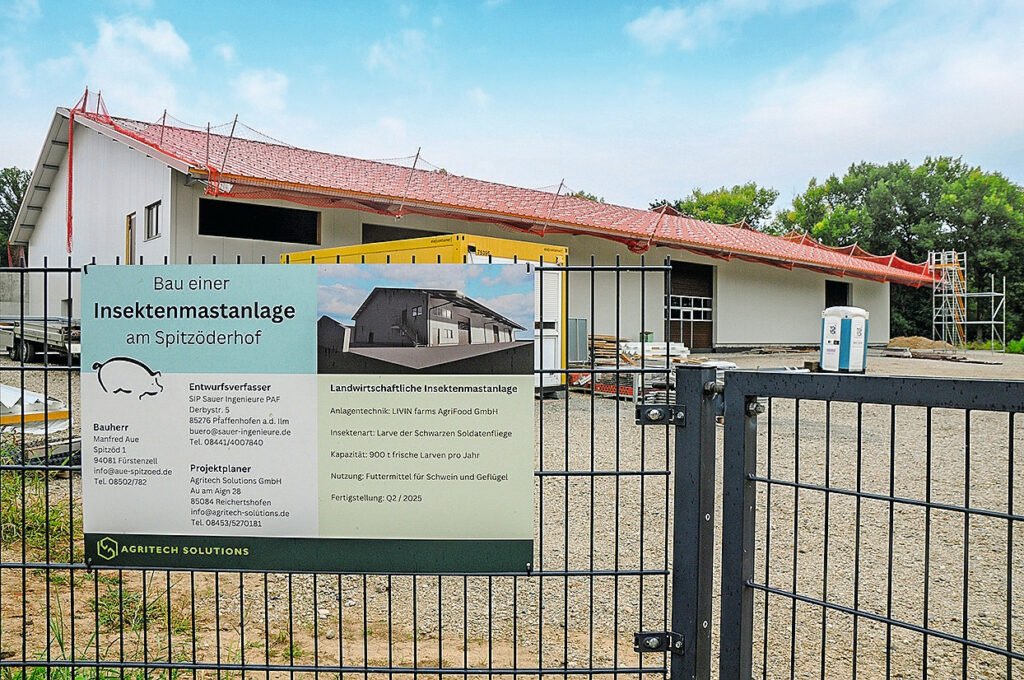
Together with his wife Elisabeth and 3 permanent employees, he keeps 350 sows and raises and finishes some of the piglets himself. He also recently built a 60 m long and 25 m wide hall on the premises, where he is setting up a fattening facility for insect larvae worth several million euros, ready to start producing early 2026. At the same time, Aue is expanding the biomass heating system to 500 kW, which is primarily fuelled by wood chips from his own production. About 200 kW is needed to heat the hall and the climate chambers where the larvae will grow. The goal: an annual production of about 1,000 tons of larvae.
Larvae fattening as a new income stream
What was it that convinced Aue? He and his wife also wanted to expand the business. He admits, “During the price crisis 4 years ago, we were on the verge of quitting sow farming, despite good performance. With larvae fattening, we are now creating an additional source of income, because we want to sell two thirds of the larvae produced.”
Why did the producer, who weans 32-34 piglets per year from his Danish sows, choose larvae fattening as a new business line? He says, “The deciding factor was our positive experience with feeding insect larvae.”
Replacing soy with fermented rapeseed meal
It all started with his search for a high-quality, local and sustainable protein source for his piglets. He has been feeding his sows and finishing pigs fermented rapeseed meal, completely soy free, since 2015. As he normally sells 90% of his finishing pigs to local butchers, he asked them beforehand what they thought of the plan to work without soybean meal. His buyers responded positively.
After switching from soybean to rapeseed, growth rates remained stable at about 900g per day. Feed conversion ratio (FCR) improved by 0.15 to 2.62, thanks to enzymatic predigestion with lactic acid bacteria. Furthermore, according to his butchers, the fat consistency improved compared to that of the animals fed on soybean meal.
Where fermented rapeseed meal successfully managed to entirely replace soy for sows and finishing pigs, it did not work for grower pigs. An alternative option became available as from 2021 when insect larvae were approved as animal feed. Aue decided to test them on his growers.
Live larvae trial
He bought live larvae and offered them to the piglets. They quickly devoured them. Aue says, “It would not be animal friendly to only feed our pigs on plant-based feed.” After all, wild boar also root for insects in the soil. To test how larvae feeding would affect performance, Aue conducted a field trial. A control group of 50 piglets was fed the usual soy ration after weaning. The test group received the same feed, but also received live larvae in a feed trough.
Aue explains, “We started with 10g of larvae per piglet per day and increased that to 250g per piglet per day up to 48 days.” In total, the piglets received 6kg of larvae, at a cost of about €1/kg. He repeated the trial twice.

Larvae feeding boosts growth after weaning
The results surprised him. The control group gained an average of 481g per animal per day, while the larval group gained 693g. After 48 days, the grower pigs in the control group, on average, weighed 31.1kg, while those in the larval group weighed 41.3kg. In addition, the grower pigs fed on larvae were calmer. Aue says, “Perhaps keeping the piglets long-tailed works better with insect larvae in the ratio.”
He is convinced that it is not just a matter of nutrients, but also related to the fact that the larvae are fed alive. Since the larvae move, it keeps the grower pigs more active. Feeding the larvae alive has been legally permitted in the EU since 2021; feeding unprocessed dead larvae is not.
Ever since these positive results, Aue has been purchasing insect larvae. The grower pigs receive them in their troughs straight after weaning for a phase of nine days. During that phase, the animals remain in the farrowing pen before being moved to the rearing pen or being sold.

Better animal health
The weaned piglets’ health has clearly improved. Aue says, “Unlike before, we now manage the weaning phase without antibiotics.” He adds that the sales weight of his weaned piglets has increased from 8 to 9 kg.
Aue says, “The larvae alleviate the stress phase after weaning.” If tail biting occurs in finishing pigs, he also feeds the animals larvae as well as alfalfa pellets in an empty trough for 2 weeks. That noticeably calms the animals. Aue adds, “However, adding larvae to the mash feed is not permitted and is also not beneficial, because they are barely chewed on and get poorly digested.”
Growing larvae: Efficiency as key to economic success
His positive experiences have convinced him to start breeding the larvae himself on a large scale. He knows that economic success depends on efficiency. Aue explains, “Just like in pig finishing, I only make a profit if everything aligns well.” This is why he opted for a 2-phase larvae finishing system, in which the larvae are being fattened from day one. After 5 days, they are removed from the climate chambers, divided into larger bins and fattened for another 6 days.
The concept originated from Agritech Solutions, which is providing guidance in the process. The technology and software come from Livin Farms Agrifood in Vienna, Austria; the feeding technology from Schauer in Austria.
Larvae growth will take place in the new hall, which is fully insulated. All processes are fully automated – from preparing the breeding boxes, distributing the larvae, stacking and placing them in the climate chambers, to sieving the larvae. Aue says, “Production must run 24/7 without any manual labour.”

At full capacity, the facility is expected to produce 1,000 tons of larvae. He plans to use a third of these larvae himself, and the rest will be sold. Because larvae fattening is considered an agricultural activity, he is only permitted to market live larvae. Therefore, they must be quickly cooled to 5°C at the end of the process to temporarily inactivate them. Transport and storage also require a cold chain.
Jointly entering the market
To develop sales markets, Aue, along with 7 other larvae producers, founded a produers’ organisation called Insektivo. The initiator is Agritech Solutions. In addition to sales, the cooperative must also purchase affordable feed materials for the larvae, such as wheat and flour by-products. Three members operate large biogas plants that can effectively utilise the larvae waste – sieved manure and feed residues.