Heat stress is now one of the major challenges facing modern poultry production. Poultry are sensitive to heat, and their performance and welfare deteriorate rapidly under heat stress. It is becoming essential to understand this phenomenon in order to better manage it.
The effects of heat stress in poultry manifest themselves in 2 ways, namely oxi-inflammation as a physiological response, and panting and decreased consumption as a behavioural response.
Oxi-inflammation as a physiological response
An increase in ambient temperature raises the body temperature of chickens. Metabolic reactions are no longer optimised and produce more free radicals (ROS), which trigger a sub-inflammatory response that increases heat production. These physiological phenomena are responsible for drops of 10 to 40% in performance declines in poultry.
Panting and decreased consumption as a behavioural response
Decreased feed consumption enables the animal to reduce its heat production. This energy adaptation due to heat stress is responsible for more than 60% decrease in performance. We also observe an increase in water consumption and panting behaviour in an attempt to lose heat.
The first thing to do: reduce heat perception
The first step in combating heat stress is to limit its perception by poultry. Increasing the air speed can reduce heat perception by 2 to 4°C, depending on the air speed and humidity level. However, as it is not possible to exceed 2 m/s without causing further discomfort to the birds, the mechanical approach stops at 28°C. Beyond that, path-cooling can be considered, which can reduce the temperature by 5 to 8°C.
In practice, there is always residual heat stress that continues to incur significant losses (more than US$2 billion in the US alone, which is not the most exposed country). Production costs are increased by 7 to 35% depending on the level of heat stress.
Improve physiology response: the role of feed additives
Nutritionists use different nutritional strategies and often use feed additives to better support the animals. Physiological changes are addressed by a wide range of feed additives that combat oxidative stress or sub-inflammation caused by heat.
For oxidative stress, however, molecules capable of reducing oxidative stress in fatty (membranes) or aqueous (cytoplasm) compartments should be favored. Grape polyphenols are powerful antioxidants that can do this job at very low doses (10 to 50 ppm). To ensure their ability to protect both the cytoplasm and the membranes, very small polyphenols with a high procyanidin content should be selected.
For the modulation of inflammation, molecules that directly target the COX2 pathway should be chosen in order to respect the integrity of the intestinal mucosa. The advantage of curcumin is its simultaneous effect on the COX2 and NF-kB pathways. This active ingredient can therefore be used chronically without risk of erosion of the gizzard or intestine mucosa. To maintain its effectiveness, protected small-size particle (nm scale) forms should be preferred.
Using animal behaviour for better adaptation to heat stress
The adaptation of animals to heat stress with behaviours that end up detrimental to their health, welfare and performance, is too often considered inevitable. But have we really explored all the options? For example, birds hyperventilate, which seems inevitable when it is hot. So, we rightly modify the ionic balance of minerals by adding electrolytes. Yet, is this the only lever to help poultry better adapt during heat stress periods?
If animals change their behaviour, it is because they identify a significant stressor. So significant, that they often end up resigning themselves to not moving in the case of heat stress. Panting should be considered a behaviour of resignation. At this stage, the animals no longer behave appropriately. They no longer move, they are panting and risking alkalosis, and they do not drink enough at the peak of heat (immobility).
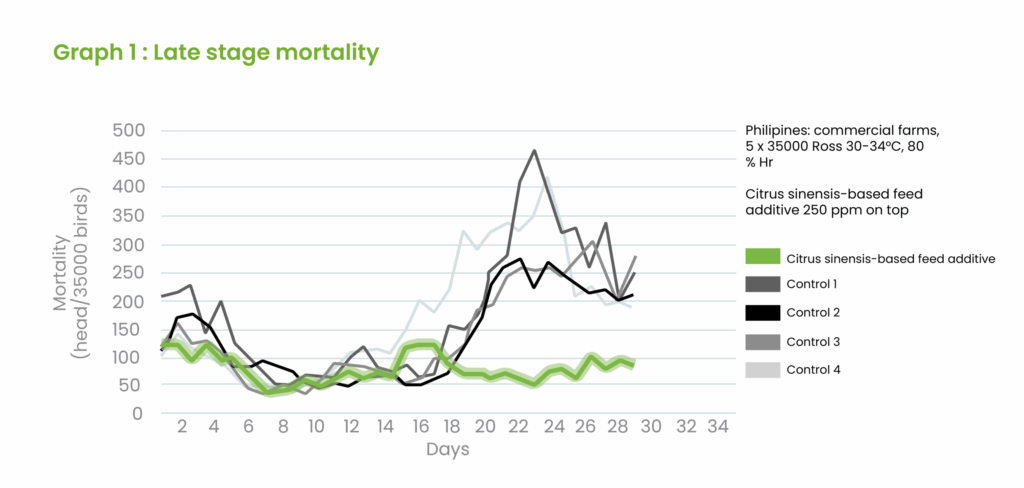
Alleviating resignation to heat stress has been proved possible (VeO, Laboratoires Phodé): animals move more, ventilate less, and this drastically reduces late mortality (Graph 1). The icing on the cake is that by moving more, the animals also peck significantly more feed (Graph 2).

Behaviour is directly connected to the brain. Adjusting or breaking behaviour patterns during stressful conditions means using the brain path. For such a solution, feed is an excellent way for the brain to pick up messages through sensory receptors. Complementary to flock management and nutrition, using a feed additive that targets behaviour is a powerful lever to limit the detrimental effects of heat on poultry:
- It reduces resignation behaviour (panting)
- It increases animal locomotion and water intake
- It saves lives (late-stage mortality)
- It restores up to 50% of lost feed intake
Are you ready to restore poultry’s positive feeding behaviour?
References are available on request.