Maintaining proper fish health in aquaculture is crucial to avoid incurring significant economic losses. While gut health often takes centre stage, the skin and gills are also critical first lines of defence.
Prebiotics are generally included in aquafeed formulations as functional feed materials to help support normal immune function and enhance nutrient absorption, digestion and, ultimately, the animal’s performance. Along with their ability to effectively outcompete pathogenic bacteria and discourage adhesion, these health-promoting bacteria can also ferment prebiotic substrates, producing short-chain fatty acids, which help boost intestinal functions by increasing mucus and supporting immune response.
From the gut to skin and gill health
While much research has focused on the effects of prebiotics on fish gut health, other mucosal surfaces are often overlooked. Nevertheless, skin and gills also act as a critical first line of defence for a fish’s overall health, as these large surface areas are exposed to the aquatic environment and, therefore, serve as primary targets for pathogen attachment and invasion in finfish.
The mucus layer covering the epidermal and gill epithelial surfaces is not just a physical barrier; it contains potent immunologically active molecules, underlying mucosa-associated lymphoid tissue elements and microbiota, which facilitate the development and homeostasis of the host fish’s immunity. However, under stressful fish farming conditions (e.g., high stocking densities, fluctuating temperatures in open systems due to climate change), a disruption of the symbiotic host-microbiome relationship can lead to significant changes in the microbiota structure, which favours the growth of opportunistic pathogens.
Pathogenic challenges
Bacterial and parasitic agents cause severe, unpredictable and difficult-to-treat infections on the skin and gill surfaces while causing financial losses for producers. For example, the parasitic copepod Lepeophtheirus salmonis, which is responsible for sea lice infestations in salmon farms that cause skin wounds and secondary infections, significantly impacted revenues and led to financial losses estimated at US$436 million for the Norwegian aquaculture industry in 2011. As aquaculture evolves, sustainable disease management strategies will be required to protect animal welfare, health, the environment and the producer’s profitability.
Mannan-rich fraction
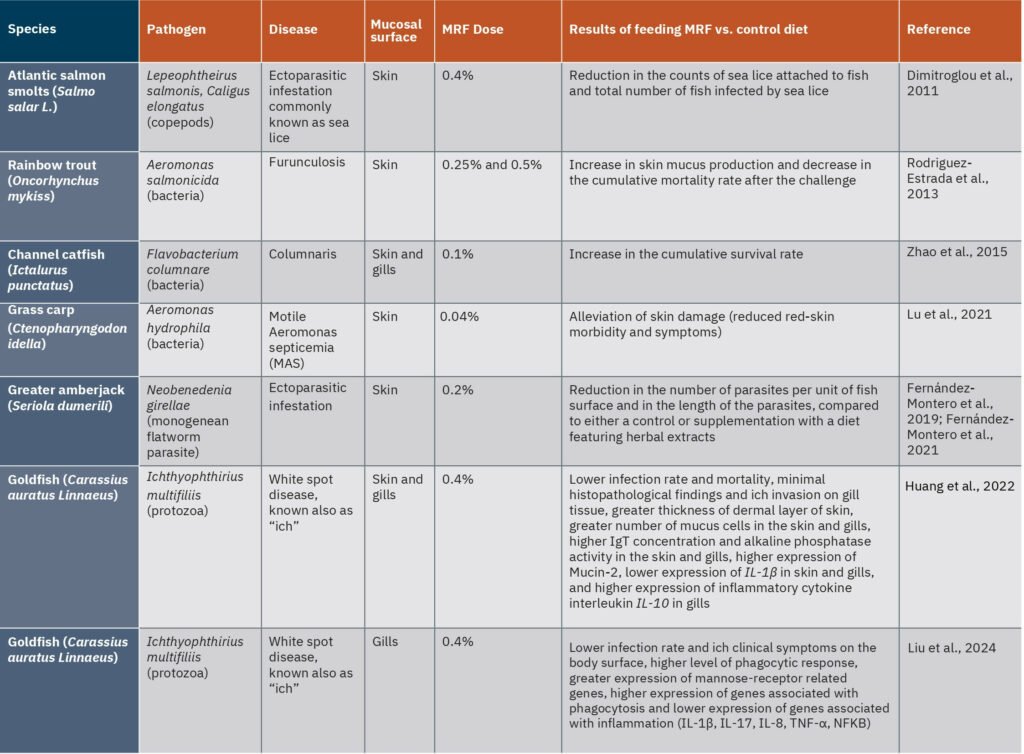
Alltech’s mannan-rich fraction (MRF), derived from the cell wall of a select strain of Saccharomyces cerevisiae, is among the most studied functional feed materials in farmed animals. Research findings support MRF’s protective role against various health challenges in skin and gills across different fish species, including salmonids (salmon and trout), freshwater species (catfish and tilapia), marine species (greater amberjack) and ornamental fish (goldfish). Some of those key findings are summarised in Table 1.
Protective roles
Feeding trials without pathogenic challenges have shown the potential of MRF to support normal functions of the mucosal immune barrier. In a study of rainbow trout, skin mucus production increased after 12 weeks of feeding MRF. In studies in goldfish, longer gill lamellae, greater thickness of the dermal dense layer of skin, the number of mucous cells in the tissues of skin and gills, and an upregulated expression of genes related to Mucin-2, mannose receptors, phagocytosis and inflammation were noted after 60 days of feeding MRF.
 The results of other trials across different fish host species have confirmed the activation of the necessary mechanisms that support the mucosal immune barriers’ normal functioning, discourage the adhesion of pathogenic bacteria, and impact the immunological responses of the challenged fish fed with MRF. For instance, the dietary supplementation of MRF in the diets of Atlantic salmon was associated with a reduced total number of the parasitic copepods Lepeophtheirus salmonis and Caliguselongatus attached to the epidermis. It was also reflected in the reduced number of fish infected by sea lice (Figure 1A).
In grass carp, supplementation with MRF helped alleviate the skin damage (Figure 1D) caused by the bacterium Aeromonas hydrophila. A similar observation was noted for greater amberjack challenged by the monogenean flatworm parasite Neobenedenia girellae, which had a significantly reduced number of parasites per fish surface and a decreased total length for the parasites associated with feeding MRF (Figure 1B). In goldfish challenged by the parasitic protozoa Ichthyophthirius multifiliis, another research group demonstrated a significantly lower number of white spots and a diminished infection rate after feeding diets that included MRF.
Several studies have reported significantly higher cumulative survival rates, including in rainbow trout fed MRF and challenged by Aeromonas salmonicida, channel catfish fingerlings fed MRF and challenged by Flavobacterium columnare, and goldfish fed MRF and challenged by ich. These studies attributed this protection to the positive impact of MRF, which is correlated with the altered expression of inflammatory cytokines and immunoreactive substances (e.g., lysozyme and alkaline phosphate activities) that favour resolution and repair processes.
Conclusion
Diseases cause significant losses in aquaculture operations, and investing in control and mitigation techniques is essential for a farm’s economic sustainability. Research has shown that dietary tools such as MRF technology are cost-effective solutions that can help nutritionists formulate diets that boost physical mucous barriers, discourage the adhesion of pathogenic bacteria and support normal immune responses. This extensive research demonstrates the holistic protection of MRF beyond gut health, highlighting additional protective effects on the skin and gill surfaces across various species.
References available upon request.