Arginine (Arg) plays a vital role in avian metabolism far beyond its involvement in creatine synthesis to provide rapid energy. It serves as precursor of nitric oxide (NO), facilitating vasodilation, converts into ornithine and proline, supports polyamine biosynthesis, protein synthesis and collagen formation.
Arginine serves as precursor of nitric oxide (NO), facilitating vasodilation, whereas, guanidinoacetic acid (GAA) functions solely as a precursor in the creatine synthesis pathway. Since creatine is linked to energy homeostasis, its production is tightly regulated by rate limiting enzyme arginine:glycine aminotransferase (AGAT). If the GAA is supplemented in the diet, it may contribute to excessive amount of creatine production in muscles, if GAA is unused, it has to be converted into creatinine which needs to be ultimately excreted via urine, imposing additional metabolic costs in terms of energy and amino acid loss for the animal.
Unlike GAA, Arg not only supports controlled creatine synthesis but also fulfills a multitude of essential metabolic functions. Therefore, supplementation of broiler diet with Arg ensures metabolic balance, supports energy homeostasis, and avoids the inefficiencies and potential toxicity associated with excessive GAA intake.
Arginine and GAA requirements
Multiple studies have confirmed that optimal broiler performance is achieved when standardised ileal digestible (SID) arginine to lysine (Arg:Lys) ratios are maintained around 107–135% during the starter and grower phases. Under practical feed formulation CJ BIO recommends Arg as 115% of the level of Lys for best performance in broiler.
Per se, there is no established nutritional requirement for GAA in animals, as it is endogenously synthesised from Arg and Gly metabolism, requiring methionine (Met).
Role of arginine in energy utilisation
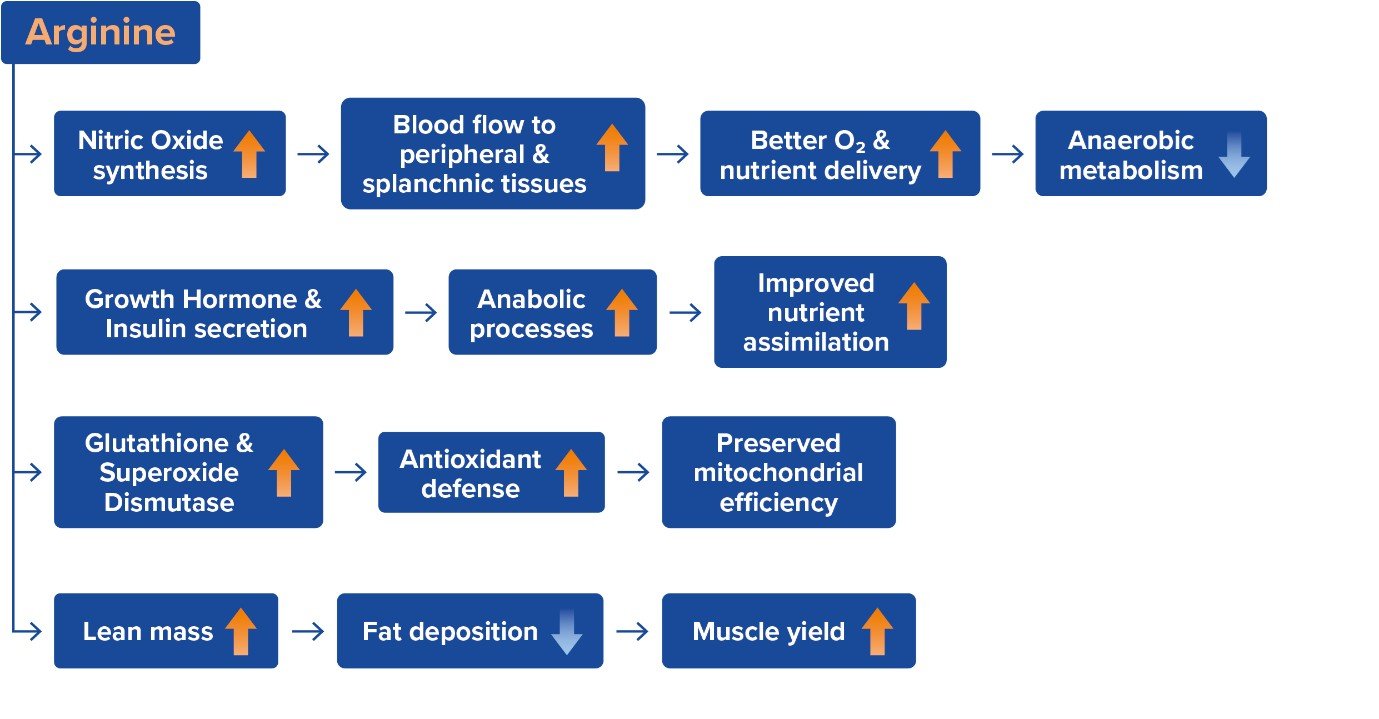
Arg improves the utilisation of available metabolisable energy (ME) through different metabolic pathways:
- Arginine improves the ME utilisation through NO, which improves blood flow to peripheral and splanchnic tissues, optimising oxygen and nutrient delivery.
- By promoting growth hormone and insulin secretions which enhances anabolic process and nutrient assimilation.
- Arginine improves the antioxidant defense by increasing glutathione and superoxide dismutase (SOD) which improves mitochondrial efficiency and ultimately energy delivering process to the cells.
- Arginine supports lean mass accretion, reduces fat deposition, improve gut morphology and barrier integrity which leads to enhanced nutrient absorption and net energy extraction from feed.
Figure: Roles of arginine in different metabolic pathways
Limitations on Arg sparing paradigm
Arginine sparing effect of GAA is conditional which is not equivalent to supplementing Arg itself:
- Conversion of GAA to creatine requires methyl groups per mole of creatine, if the diet is hardly meeting the requirement of methionine, choline and betaine, this may counteract the net energy benefit due to increased methylation burden.
- GAA cannot contribute to direct metabolism of NO, polyamines and proline. Under different stress conditions, Arg demand increases disproportionally, even access GAA in the diet cannot meet these additional metabolic demands.
- If the diet is marginal in Arg, GAA supplementation could not fully restore the performance, indicating that Arg sparing effect of GAA is incomplete and cannot fully replace Arg.
In a recent study Verhelle & Saremi (2025) conducted a pair of performance trials in broilers using Arg-deficient diets and observed that GAA supplementation partially restored growth performance, indicating that exogenous GAA can relieve some of the Arg burden under sever Arg deficiencies something which is never happening under normal commercial conditions. The authors estimated an Arg:GAA equivalence ratio of ~1:0.57, while a 1:0.77 or 1-1.49 ratio is argued. Why the ratios are in such a range and what are the complications remains to be elucidated.
Benefits of Arg in least cost formulation as compared to GAA
Under practical conditions, the inclusion of Arg depends on the raw material costs, physiological needs, and price of Arg. In the contrary, the formulator has to push the GAA into the feed formula by fixing the inclusion at a minimum of 0.6 g/kg of feed.
Even though it may be more cost-effective to meet the animal’s Arg requirements through raw materials, supplementing GAA can displace these ingredients in the formulation, potentially leading to imbalanced nutrient supply and reduced dietary flexibility which may increase the formula cost too. Moreover, Arg specifically covers a particular amino acid demand in a straight forward manner, while GAA lacks clarity on how much Arg does it spares (0.50, 0.77 or 1.49).