New research highlights the potential of Algimun, showing that a combination of macroalgae-derived sulphated polysaccharides can strengthen natural defences, primarily through immunomodulation and improved mucosal barrier integrity in broilers challenged with necrotic enteritis.
Necrotic enteritis remains one of the most economically significant enteric diseases in poultry production, driven primarily by Clostridium perfringens and often exacerbated by coccidial infections. With global losses estimated in the billions and increasing regulatory pressure to reduce antibiotic use, the industry is intensifying efforts to identify effective natural strategies that can sustain broilers’ health and performance under disease pressure.
Olmix, in collaboration with the University of Georgia under the guidance of Dr Dalloul, conducted a study on marine sulfated polysaccharides extracted from macroalgae as a natural solution to mitigate the impact of necrotic enteritis in broiler chickens. The findings indicate that macroalgae-derived sulphated polysaccharides (MSPs) offer benefits comparable to those of conventional antibiotic growth promoters, particularly in terms of gut integrity, immune modulation, and overall survival and performance.
The study used a controlled necrotic enteritis challenge model involving co-infection with Eimeria maxima and C. perfringens. 600 broilers were allocated into 4 treatment groups: a negative control, a positive control with growth promoter antibiotic, and 2 groups receiving Algimun (MSP Barrier and MSP Immunity) at inclusion rates of 0.1%. Across a 42-day period, researchers assessed performance parameters, lesion scores, mortality, inflammatory biomarkers and gene expression related to immune response and tight junction proteins.
Performance under challenge
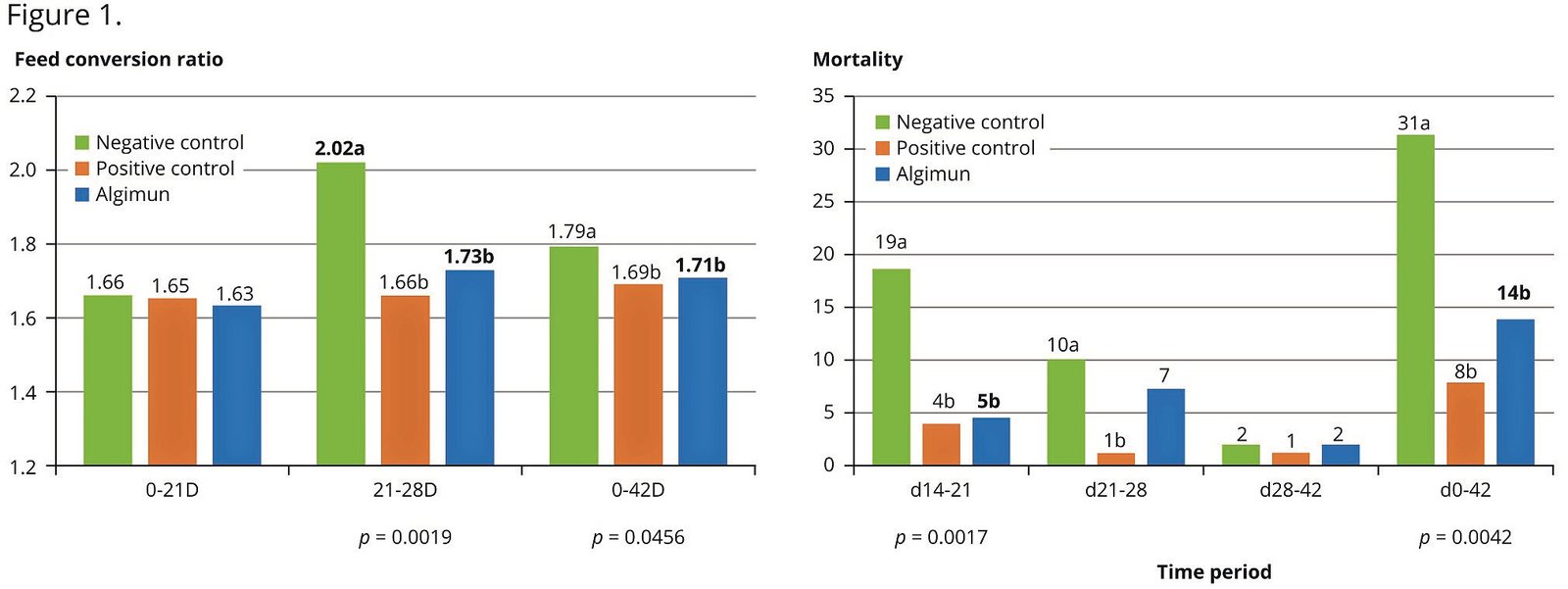
 Broilers receiving the MSPs demonstrated clear improvements in key performance indicators, comparable to those in the antibiotic group. Average daily gain increased significantly over the full production cycle, while feed conversion ratio improved, despite the health challenge. Cumulative mortality at 42 days was significantly reduced in the Algimun group, which was comparable to the antibiotic group. This parity suggests that MSPs could help fill the performance gap often associated with antibiotic-free production systems (Figure 1).
Lesion scoring further supported these findings. Broilers in both groups exhibited significantly lower intestinal lesion severity at the peak of infection, indicating that MSPs protect gut integrity. Reduced lesion severity is particularly relevant in necrotic enteritis management, as intestinal damage directly impacts nutrient absorption and growth performance (Figure 2).
Modulation of inflammation
A central aspect of the study was the evaluation of calprotectin, a biomarker of intestinal inflammation. Elevated calprotectin levels are associated with immune activation and tis sue damage.
At the peak of infection, birds receiving the 0.1% inclusion level of the MSPs showed significant immunomodulation, with higher anti-inflammatory and lower pro-inflammatory cytokines. These results indicate reduced inflammatory responses, suggesting that MSPs help limit excessive immune activation. This is a critical factor in maintaining productivity, as chronic inflammation diverts energy away from growth.
Strengthening gut integrity
Beyond immune modulation, the study highlights significant effects on intestinal barrier function. Tight junction proteins, such as claudins, occludin, and zonula occludens, play a crucial role in maintaining gut integrity and preventing pathogen translocation.
Broilers receiving the MSPs showed increased expression of several of these proteins, particularly during the pre-challenge and recovery phases. Enhanced tight junction integrity likely contributed to the reduced lesion scores and improved performance observed. Maintaining a robust intestinal barrier is increasingly recognised as a cornerstone of poultry health, especially in antibiotic-free systems where birds may be more exposed to enteric challenges.
Conclusion
The researchers’ findings provide compelling evidence that Algimun can mitigate the adverse effects of necrotic enteritis in broilers. The biological activity of marine sulphated poly saccharides (MSPs) is linked to their complex molecular structure, which includes sulphate groups and diverse sugar residues. These features enable interactions with immune receptors and signalling pathways, influencing both innate and adaptive responses.
Additionally, their effects on gut barrier function may involve modulation of epithelial cell signalling and reinforcement of intercellular junctions. The combination of antimicrobial, anti-inflammatory, and barrier-supporting properties makes these MSPs particularly attractive for integrated gut health strategies.
References are available upon request.