Celebrating 6 decades of scientific innovation, CCPA Group recently marked its 60th anniversary with a 2-day event in Paris. The milestone was both a tribute to its pioneering journey and a look ahead at how the company is meeting today’s challenges and building a sustainable future, all anchored by its core values.
The event started off with several speakers looking back at CCPA’s journey over the last 60 years. Jean-Luc, director of agriculture at the Altitude Cooperative, has been in collaboration with CCPA for 35 years and explains that it all starts with cooperative values: “The most important word for our story is trust, built over time.” Former CEO of the CCPA group Jean-Jacques explains how the company had to adapt as the world changed. During his time at the company they expanded internationally, invested in research, and even worked with competitors: “We did the opposite of what everyone said, and that’s how we made a difference.” One example of these collaborations is with the company Phytosynthèse. According to Sylvain Kerros, R&D director, this led to new natural solutions for animal health: “From the very beginning, CCPA was one of the first companies in Europe to truly challenge and innovate with these solutions. They took the risk of working with us to develop and test their effectiveness in the field. They didn’t just want plant supplies; they wanted to understand them.” The speaker emphasised that CCPA has grown by staying open to change and continuously responding to society’s expectations.
“The most important word for our story is trust, built over time.” – Jean-Luc, Director of Agriculture, Altitude Cooperative
Trust in science
Etienne Klein, physicist and philosopher of science talked about our relationship with science, progress, and innovation. He discussed the role of science and knowledge in society today. Klein explains that trust in science remains high but is often misunderstood because science is seen in different ways. He says that science is not only about certainty, but about understanding what we do not yet know: “Science helps us know what we do not know.”
Klein also warns that common sense can be useful but misleading: “Common sense is essential for survival and daily life, but it is not designed to discover truth. It works, but it can also mislead us.”
The philosopher also highlights how public debate is often shaped more by opinion than expertise. “Today there is social pressure and sometimes distrust toward agriculture. CCPA helps bridge belief and knowledge by producing objective data and scientific evidence, for example on animal welfare and nutrition.”
Finally, he distinguishes between innovation and progress, explaining that they are often confused: “Innovation is about maintaining systems, progress is about shaping the future.”
“We must significantly increase investment in innovation, ideally doubling it, to provide better solutions for sustainability and trust.” – Michaël Marcerou, Chairman of CCPA
Today and the future
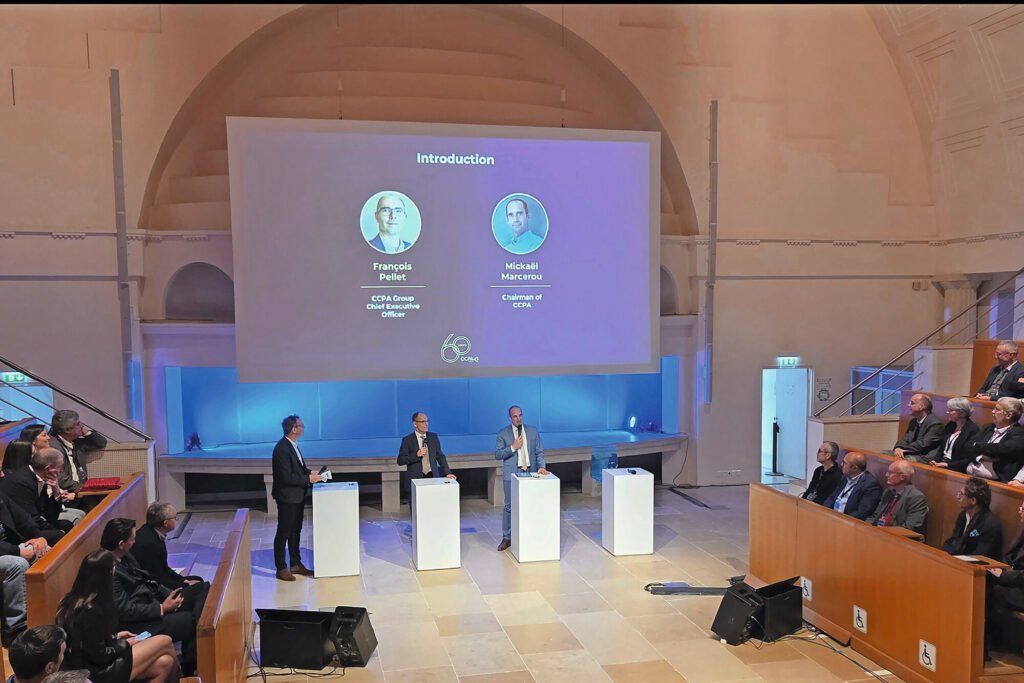
François Pellet (CEO) and Michaël Marcerou (Chairman of CCPA) gave a presentation on the company’s current performance and future outlook. François Pellet began by emphasising the importance of the shared mission of the company: CCPA is the 500 men and women you meet every day in the company. They are united by a shared mission: to combine their expertise with passion to enhance the competitiveness and sustainability of animal production sectors. In numbers, the company comprises 200 subsidiaries, generates €220 million in revenue, produces around 12 million tonnes of feed worldwide, operates 9 factories and 5 laboratories that perform over 400,000 analyses per year, and invests more than €5 million annually in innovation.
Michaël Marcerou sees the next 10 years as a collective journey, driven by teams and the board working together rather than individual leadership. He emphasises international growth through regional platforms in markets such as Mexico, Turkey, Asia, and Brazil, while also learning from these regions rather than only bringing solutions. As he explains: “We must significantly increase investment in innovation, ideally doubling it, to provide better solutions for sustainability and trust,” while staying focused on CCPA’s core mission of serving clients and farmers, supported by strong collaboration and long-term trust.
To celebrate its 60th anniversary the company unveiled its new brand identity. This new identity strengthens our visibility and the clarity of our offering internationally, while also reinforcing our employees’ sense of belonging,” said François Pellet.
Plant-based innovation
On the second day of the celebration event, Fabrice Robert R&I manager, phytoexpertise and datasciences at CCPA describes in his presentation a new way of feeding animals: “augmented nutrition,” that uses data from farms and natural ingredients to give the right nutrients at the right time. Fabrice Robert explains that this will help animals handle stress and stay healthy. He emphases the role of phytotechnology: “In the plant world, there are tens of thousands of active molecules with pharmacological effects that can be used in animal production to improve resilience and performance. To use them effectively, we must change the way we work. Nutrition is, in fact, pharmacology.” He adds: “This is the idea behind ‘augmented nutrition’, which combines nutrition with pharmacological understanding of biological effects.”
Cellular nutrition
Marisela Arturo-Schaan, group CSR manager & natural ingredients presented a new approach, called the cellular approach, consists of understanding and demonstrating the action of ingredients at the cellular level. She adds that CCPA is unique in offering this multi-model cellular approach that is specifically designed to test functional ingredients in animal nutrition and optimise the dosage levels to achieve positive effect on the target organs.

Performance based formulation
Subsequent speakers discussing the company’s formulation software highlight that in the future it will not only evaluate the nutritional value of raw materials, but it will also include health, environmental, animal welfare and performance indicators. Amélie Gavard, formulation department manager: “We will move from feed formulation to performance-based formulation.”
The speakers explain that animal nutrition is increasingly based on data from sensors, farms, and animals to make better decisions on the farm. The company integrates large databases of feed ingredients, nutritional values, and animal needs into useful tools to optimise feed formulation, reduce costs, and improve productivity. As one speaker stated: “We must turn data into a decision-support tool.”
Collective solutions
Marina Panheleux states that valorisation, making the most of resources without losing value, is a collective challenge that requires integrating the entire value chain. “we will not succeed, as everyone would work separately.” In animal production she says the main issues to consider are climate change, competition for land between human food and animal feed, and air quality. And animal nutrition is a major contributing factor. Panheleux and her colleague Paula Higuera, project manager, ecodesign and LCA presented several tools and solutions, such as life cycle analysis and data modelling, to measure and reduce impacts like climate change, land use, and emissions, while keeping economic performance in mind. According to the speakers, it’s key to use the right tools without getting lost in complexity. They explain that CCPA uses these tools to simulate different scenarios, optimise feed formulations, and guide better decisions for sustainability. With as goal: “To produce better, but also more, with fewer resources.”