Solid-state fermentation (SSF) offers exciting potential for enhancing the nutritional value of animal feed, but has remained out of reach for many producers. Now, 2 European experts are pioneering a simple, flexible SSF method designed for both feed mills and home mixers. Their plug-and-play system could soon make high-value fermented protein ingredients accessible and affordable worldwide.
Metaphors come in handy when trying to explain processes on a microbiological level. With a smirk, Dr Heinrich Kleine Klausing likes to speak of his “employees” who do their job for feed producers, when referring to lactic acid bacteria. After all, these bacteria take centre stage in the process of solid-state fermentation (SSF).
Next to him is Dr Ronald Scholten – who knows another metaphor. A fermentation process, he says, is a bit like a war. Rhetorically he asks, “If you go to battle and you send a million sleeping soldiers to the front, will they make you win?” and he continues, “However, if I activate my soldiers before going to battle – that is when I will win.”
Activation of soldiers
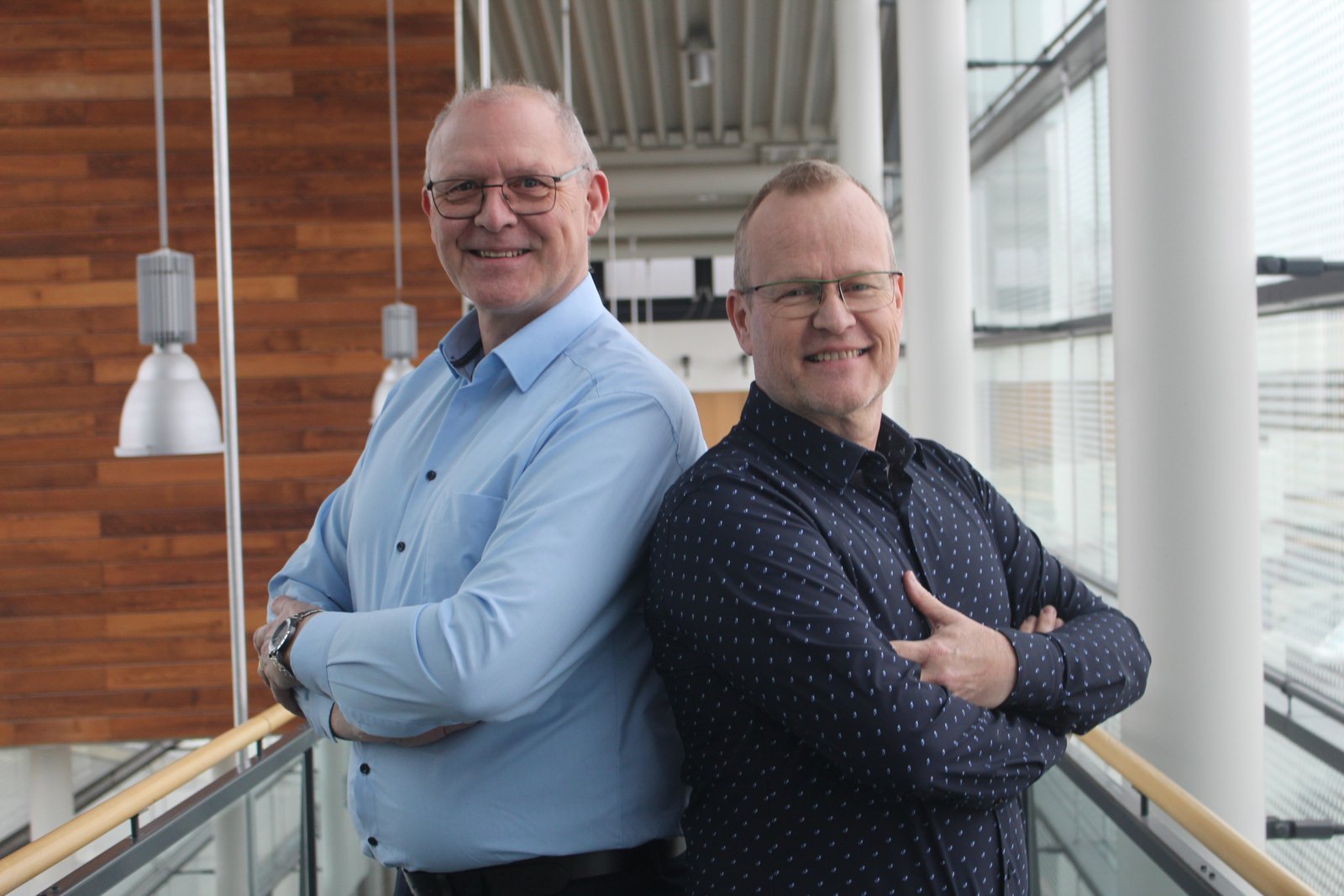
Activation of lactic acid bacteria is one of the key components of the SSF concept the two experts are working on. The two met at the trade show VIV Europe 2018, learnt about each other’s specific qualities and acknowledged there was potential for further cooperation. Dr Scholten has lifelong experience in fermentation processes – from his PhD thesis subject to being a renowned expert on liquid fermentation, with his “Dr. Ferm” consultancy. He had long wanted to explore the possibilities of making SSF available to a wider range of producers.
Nutritionist Dr Kleine Klausing spent many years at the helm of, for example, Deutsche Tiernahrung Cremer, known from the brand Deuka – and, as such, has many years of making animal nutrition ideas and products go to market. His recent retirement did not mean leaving the world of animal nutrition, completely – on the contrary.
The two men found each other in a desire to find a concept for a breakthrough for solid-state fermentation of protein raw materials. As the name says, this is a type of fermentation for which only minimal moisture is required.

The “why” behind fermenting
First things first, the “why” behind fermenting protein ingredients doesn’t need much debate – it helps young animals digest the plant proteins better at a time when the gastro-intestinal tract is still developing. One effect of fermentation is that it breaks down the amount of anti-nutritional factors, but Dr Scholten knows more modes of action, saying, “Fermentation makes that protein chains are cut into smaller parts and finally they become free amino acids. They can then be absorbed in the first part of a young animal’s intestine. That is a big help because there will be less proteins left over in the last part of the small intestine or the beginning of the large intestine.”
The importance of this is difficult to overstate. When fewer protein substrates make it to the hindgut, harmful bacteria have less of a chance to colonise there. As a result, the animals will be healthier and emission levels will be lower.
Giving a pig example, Dr Scholten speaks of soybean meal (“the golden standard”): “Ideally, 90% can be absorbed by pigs. That percentage, however, is normally measured at the end of the small intestine with pigs weighing 50 to 70 kg. A young animal will not achieve that 90%, it is maybe only 70% to 75%.”
Not a straightforward process
This as far as general fermentation is considered. Solid-state fermentation of protein raw ingredients, however, is normally a long-winded process and will also require either drying or rapid packaging in bags to avoid oxidation. For smaller feed producers – or those where labour costs are not a major bottleneck – that is not a problem. But in advanced operations with bulk production, both methods are not an option.
So how to optimise that process? The two experts formulated a two-tiered answer. One is happening in the domain of microbiology, the other is in the realm of feed processing. Both are feasible and are supported by data – now the two are on a mission to make their concept see the light of day.
Lactobacillus
First, the part of the solution where microbiology comes in. The ideal “employees” for the task of fermentation would be made of the probiotic Lactobacillus family, such as Lactobacillus plantarum (nowadays officially called Lactiplantibacillus plantarum). The exact composition is proprietary information, built on many years of experience in the Dr. Ferm consultancy.
Dr Scholten says, “We are using a dry bacteria powder and made an “idiot-proof” set-up. Any farmer or feed producer has to be able to work with it. Basically, we are selling a can containing both lactic acid bacteria and their nutrition. The user only has to add lukewarm water and store the can for 36 to 48 hours. That is when the bacteria are activated and will multiply rapidly; we call this the first-fermentation phase. After this first fermentation phase, we start using them. It is a very simple plug-and-play method.”
The next step is the addition of protein raw materials – it doesn’t matter which. Dr Scholten says, “The system offers 100% flexibility. A producer can choose to only ferment soybean meal. But if they’d like to use rapeseed meal, cottonseed meal or peanut meal, then that is also a possibility. Or guar meal like they do in India – the protein source doesn’t matter. It is the nutritionists or market prices that will decide.”
Once the raw materials are added, a decent mixing method is key, to make sure that all “employees” will have perfect access.
The fermentation process
The second part of the solution is the fermentation process – and this also involves a novel way of working. Those experienced in making silage will know that this type of fermentation process can easily take 5 to 6 weeks. The two experts, however, wanted to aim for a period that is as short as possible: three days would be optimal. To that end, a specific fermentation system is needed, to make sure everything is going smoothly under the right anaerobic circumstances. This includes temperature (25-32 °C).
Dr Kleine Klausing says, “Once the lactic acid bacteria have been mixed everywhere, you’ll have to keep them there, free from oxygen, for 72 hours, and let the “employees” do their work inside the feed particles. It is no problem to let them ferment for longer but the additional impact will slows down, since bacteria go into a kind of steady status when pH reaches around 4.”
A drying process will close off this part of the solution; after all, the result of the fermentation process will still be a product that is roughly 35% to 45% moist, albeit not as moist as the process of liquid fermentation (70% to 80%). The ideal moisture level of the final product depends on the customer: a feed mill can decide to work with 25% moisture and press it into the compound feed, whereas a company who wants to distribute the fermented product over large distances will prefer a moisture level of 10%.
Placing an additional fermentation system, however, is easier said than done. To warm up potential customers to this type of fermentation process, a mobile pilot fermentation system is currently under development. Dr Kleine Klausing says, “Our intention is to bring the mobile plant to customers and leave it there for two, three or four weeks. Then customers can produce what they need, whether they need fermented soybean meal, rapeseed meal or whatever they’d like to use. And they can conduct their own trials. In that way, they can discover the best reasons to decide to make the investment.”
The intention is to have the mobile pilot plant ready over the course of 2026, first for customers in Europe to try. At the upcoming EuroTier show in Hanover, Germany, in November 2026, the 2 hope to present a prototype fermenter.
Trials in practice
The experts are not aiming for animal nutrition companies, but rather they hope to get the attention of integrators or perhaps larger home mixers. Dr Scholten says, “For integrators, it doesn’t matter where in the chain they make the money. For them, it is much easier to accept a change, compared to a company focusing on niche markets, such as young animal feed producers. We address integrators anywhere in the world.”
Within that segment, the first gain is in broiler and aqua (shrimp) production. Not surprisingly, initial trials at the University of Hyderabad in India in 2024 and 2025 involved broiler chicks – with a high number of animals that could be included and data that could be obtained fast. In summary, up to 15% soybean meal in diets could be replaced by 15% fermented toasted guar meal, with a significant impact on FCR with an improvement of 3 points (0.03).
Dr Scholten says, “In general, what we observed in these university trials is that, in the small intestine compartments, villus height increased and crypt depth decreased significantly, hence you would see an improvement in gut health.” Dr Kleine Klausing adds, “That indicates the great importance of the various postbiotics for gut health, such as lactic acid and others, produced by the lactic acid bacteria during the solid-state fermentation process.”
Detailed results from the trials in India will be published in peer-reviewed journals in the near future. In addition, future trials with other animal species are also being planned.
For the near future
Making money is not a top priority, the men say. Dr Scholten says, “If we wanted to become rich, we’ would get out after two years, sell the concept, cash in and say ciao. Instead, we want to bring it to integrators and feed millers and help address the challenges they face. If you look at all individual problems and challenges, from more efficient production, to a lower carbon footprint or reduced nitrogen emissions, fermentation is a fitting solution. We strongly believe in it. Now, it is still a concept, but it will slowly become implemented.”
Closing off with another metaphor, Dr Kleine Klausing compares the development to electric cars. He says, “The first ones to adopt new technology were the crazy ones, even though we all knew this would be the future. Most other people waited – if only there would be an electric car that could drive for 700 or 800 km, then they’d certainly take it. That is why we are making the pilot plant, so customers can see that it works.”